1. A small unmanned aircraft that weighs 0.45 lb (approximately 204 grams) and is used for recreational flying is:
Drones flown purely for recreation do not need to be registered if they weigh 0.55 lb (250 g) or less, so this 0.45 lb recreational drone is exempt. The exemption is for recreational flying only: under Part 107 every drone must be registered, whatever it weighs. The first option is wrong because being an unmanned aircraft does not by itself trigger registration for a recreational flyer. The third option is wrong because flying near an airport does not change the registration requirement.
Regulations
2. A Category 3 drone is used to inspect a construction site with restricted access. Under which condition may it fly over the workers on the site?
Category 3 flight over people is allowed within or over a closed- or restricted-access site when everyone on the site is on notice that a drone may fly over them. (Outside such a site, it must not maintain sustained flight over anyone except people directly participating or those under a covered structure or in a stationary vehicle.) Hard hats and a low altitude are not conditions in the rule.
Loading and performance
3. When is it permissible to operate an sUAS from a moving vehicle or aircraft?
Part 107 permits operation of an sUAS from a moving vehicle or aircraft provided the sUAS is not carrying any person other than the remote pilot or remote visual observer on board. The regulation does not restrict this operation to daylight hours (that is covered byPart 107's separate conditions orPart 107's own terms), nor does it require ATC authorization. The key restriction inPart 107 is the prohibition on carrying persons aboard the sUAS when operating from a moving vehicle or aircraft.
Regulations
4. At what minimum rate must a Remote ID broadcast be transmitted?
Part 107 requires that the Remote ID broadcast be transmitted at a rate of at least once per second. The 5-second and 30-second intervals do not meet the regulatory minimum and would not provide adequate situational awareness to other airspace users or authorities.
Regulations
5. Which statement about Category 3 operations and open-air assemblies of people is correct?
Category 3 drones may cause more severe injuries than Category 1 or 2 drones, so the rule bars them from operating over open-air assemblies altogether. The Remote ID and brief-transit allowances apply to sustained flight over assemblies in Categories 1, 2 and 4, not to Category 3.
Operations
6. What is the minimum visibility distance required for anti-collision lighting when operating a small unmanned aircraft at night under Part 107?
Part 107 requires that the small unmanned aircraft have anti-collision lighting visible for at least 3 statute miles and sufficient to avoid a collision. One and two statute miles do not meet the regulatory minimum specified in this section.
Loading and performance
7. When an sUAS is flying into a headwind, what is the effect on its groundspeed compared to flying in calm air at the same airspeed?
A headwind reduces groundspeed because the aircraft's velocity relative to the ground is the vector sum of its airspeed and the wind. When flying into a headwind, the wind opposes the forward motion, so groundspeed equals airspeed minus wind speed. Groundspeed cannot remain unchanged because the wind vector directly subtracts from the forward component of velocity relative to the ground. The claim that groundspeed increases contradicts basic vector addition of wind and airspeed.
Regulations
8. What standard must be met for the FAA to grant a waiver from a Part 107 rule?
Part 107 states that the FAA may grant a waiver from a rule in Part 107 if it finds that the small UAS can safely operate under the proposed conditions. There is no minimum flight-time requirement for a waiver, and the FAA—not the FSDO—is the issuing authority for Part 107 waivers.
Airspace
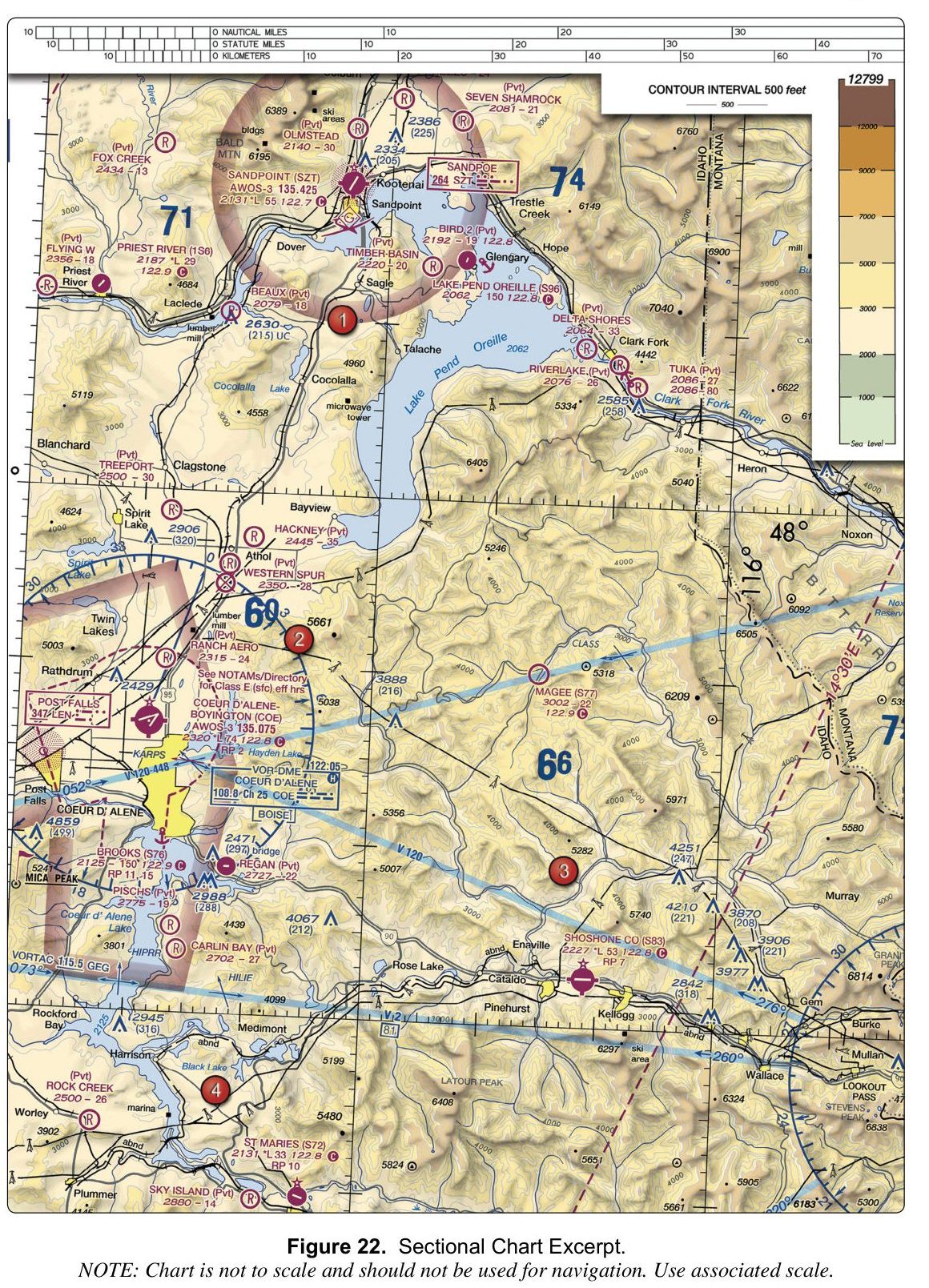
9. (Refer to FAA-CT-8080-2H, Figure 22.) What is the CTAF frequency for Priest River (1S6)?
Figure 22 — Sectional chartOpen reference image
From the FAA testing supplement (FAA-CT-8080-2H). Tap the image to open it full size.
On the chart, the Priest River (1S6) airport entry lists its CTAF as 122.9, printed directly beside the airport identifier. The value 122.8 is the CTAF for several other airports on the same chart (Lake Pend Oreille, Coeur d'Alene-Boyington, Shoshone Co, St Maries), and 122.7 is the CTAF for Sandpoint (SZT). Read the frequency printed next to the 1S6 identifier to confirm 122.9.
Regulations
10. A person may operate a small UAS without a Remote ID broadcast module if the UAS is operated where?
Part 107 provides that a person may operate a small UAS without a Remote ID broadcast module if the UAS is operated in a FRIA. Operating below 100 feet AGL or within VLOS does not exempt a UAS from the Remote ID requirement—these are operational rules under Part 107 but do not substitute for the Remote ID mandate in 14 CFR part 89.
Regulations
11. A remote pilot plans to hover a Category 2 drone above the audience at an outdoor concert to film it. What must be true for this operation?
Hovering above a crowd is sustained flight over an open-air assembly. In Categories 1, 2 and 4 that is allowed only if the operation complies with Remote ID. Category 2 eligibility alone is not enough, and nothing requires an observer in the crowd.
Airspace
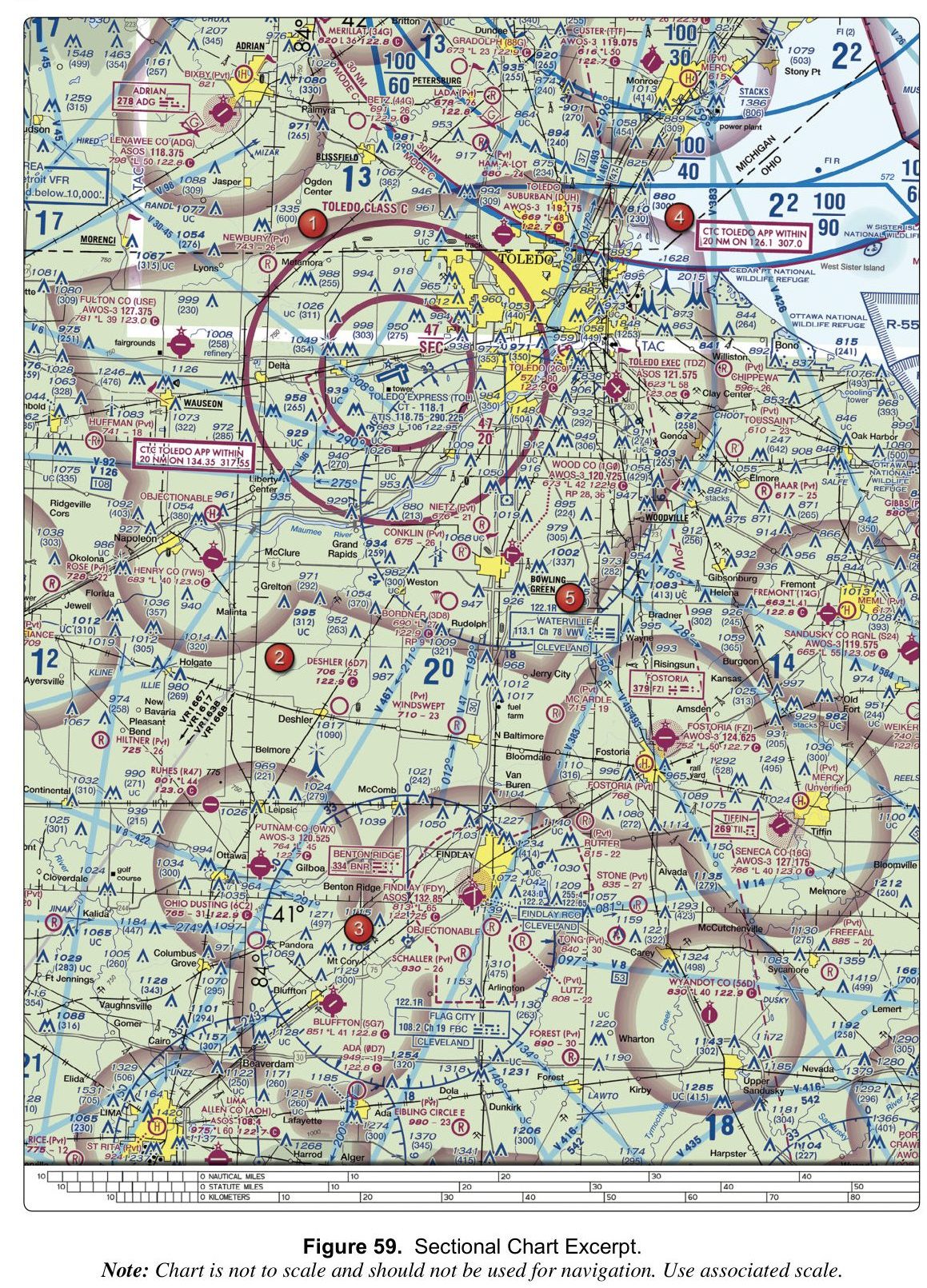
12. (Refer to FAA-CT-8080-2H, Figure 59.) What is the common traffic advisory frequency (CTAF) for Lenawee County Airport (ADG)?
Figure 59 — Sectional chartOpen reference image
From the FAA testing supplement (FAA-CT-8080-2H). Tap the image to open it full size.
On the chart, the airport symbol for Lenawee County (ADG) has the frequency 122.8 printed beside it as its CTAF. The value 122.9 is the CTAF for several nearby airports including Gradolph (88G), Bordner (3D8), Deshler (6D7), and Wyandot County (56D), and 123.0 is the CTAF for Fulton County (USE) and Ruhes (R47).
Airspace
13. A remote pilot intends to operate a small unmanned aircraft in Class E airspace that has a floor at 700 feet AGL. Which of the following is true?
Part 107 requires an airspace authorization for Class E airspace only when it has a surface area, meaning the floor of the airspace is at the surface. When the Class E floor is at 700 or 1,200 feet AGL, it does not have a surface area, and therefore an ATC airspace authorization is not required under Part 107. The regulation makes a specific distinction that not all Class E airspace triggers the authorization requirement.
Airspace
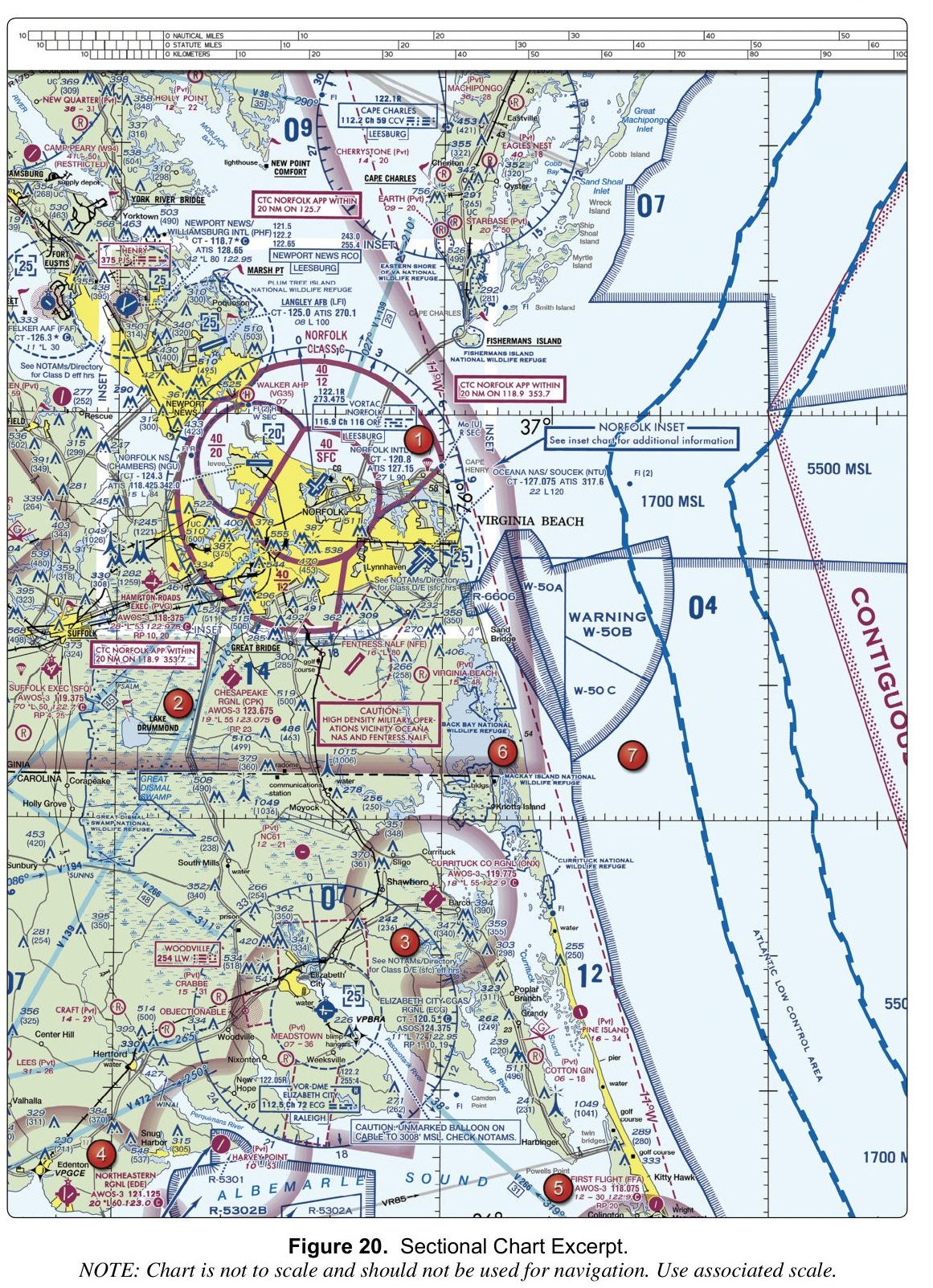
14. (Refer to FAA-CT-8080-2H, Figure 20.) What is the tower frequency for Newport News/Williamsburg International (PHF)?
Figure 20 — Sectional chartOpen reference image
From the FAA testing supplement (FAA-CT-8080-2H). Tap the image to open it full size.
In the airport data block for Newport News/Williamsburg Intl (PHF), 'CT - 118.7' is the control tower frequency. 128.65 is the ATIS frequency printed on the line below it, and 118.425 is the ATIS frequency for Norfolk NS (Chambers), a different airport on the chart.
Regulations
15. Which of the following is required before a small UAS may be operated under Part 107?
Part 107 requires that a person may not operate a small UAS under Part 107 unless it is registered in accordance with 14 CFR part 48. There is no state-level registration requirement under Part 107, and the 55-pound threshold is the upper weight limit for a 'small UAS' under Part 107, not a registration threshold—registration is required for all small UAS operated under Part 107 regardless of weight.
Loading and performance
16. When an sUAS is flying with a tailwind, what is the effect on its groundspeed compared to flying in calm air at the same airspeed?
A tailwind increases groundspeed because the wind vector adds to the aircraft's forward velocity relative to the ground. Groundspeed equals airspeed plus wind speed when flying with a tailwind. The claim that groundspeed decreases contradicts the additive nature of a tailwind on the velocity vector. The claim of no effect ignores that the wind directly contributes to the ground-relative velocity component.
Airspace
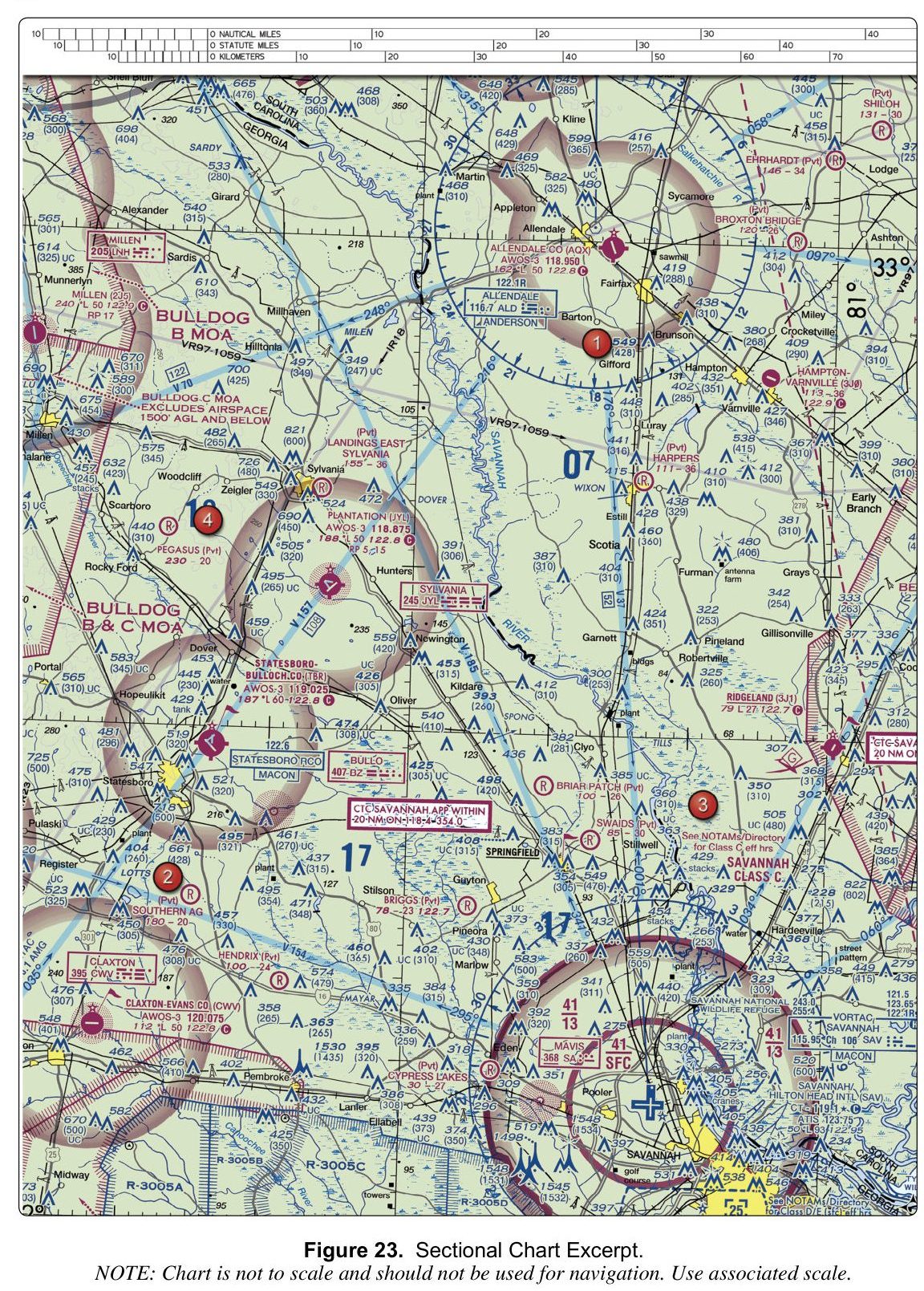
17. (Refer to FAA-CT-8080-2H, Figure 23.) The obstacle just east of area 1, near Gifford, has a height of:
Figure 23 — Sectional chartOpen reference image
From the FAA testing supplement (FAA-CT-8080-2H). Tap the image to open it full size.
Next to area 1, beside Gifford, the obstacle is labelled 549 with (428) beneath it. The bold number is the height of the top above mean sea level; the number in parentheses is its height above ground level. So it is 549 feet MSL, or 428 feet above the ground.
Weather
18. What is the remote pilot in command required to do regarding weather before operating a small UA?
Part 107 explicitly requires the remote pilot in command to be familiar with all available weather reports and forecasts for the intended area of operation. There is no requirement to obtain a briefing from a CFI, nor is there any requirement to file a weather deviation. The regulation places the responsibility directly on the remote pilot in command to personally review and understand the relevant weather information before the operation.
Airspace
19. What is the standard vertical extent of Class C airspace?
Class C airspace normally extends from the surface to 4,000 feet above the airport elevation, charted in MSL. The 2,500-foot figure belongs to Class D, the airspace around smaller airports with an operating control tower. Surface to 10,000 feet MSL is the typical shape of Class B, around the busiest airports.
Loading and performance
20. Adding additional weight to an sUAS (such as a heavier battery or payload) will have which of the following effects on performance?
Adding weight to an sUAS increases the power required to maintain level flight, which causes the battery to deplete faster, thereby reducing maximum endurance. This is a fundamental principle of aircraft performance: increased weight requires more thrust and power to sustain flight, consuming energy at a higher rate. The claim that endurance would increase is physically impossible under the same power output, and the claim of no effect ignores the direct relationship between weight and power demand.
Airspace
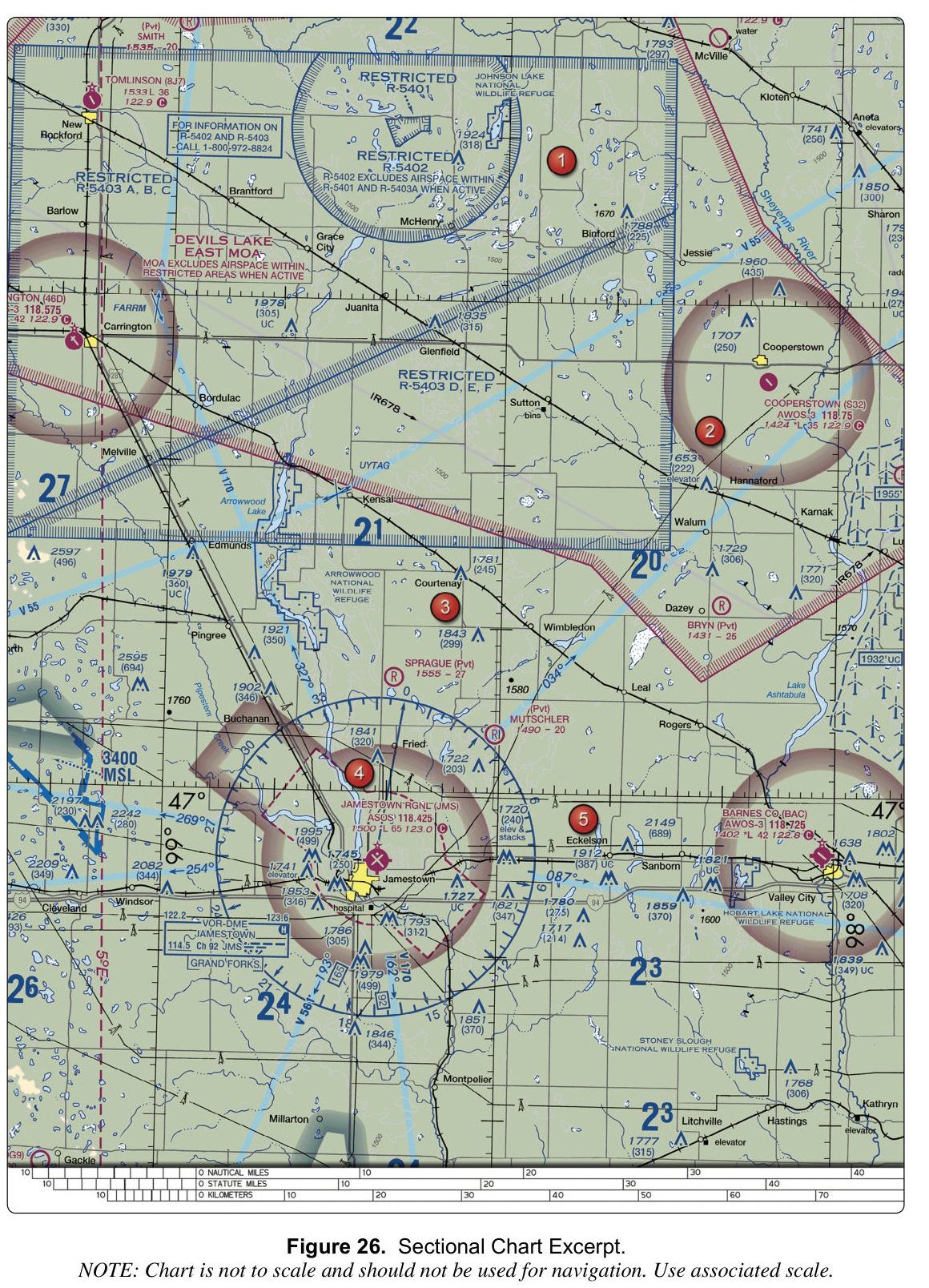
21. (Refer to FAA-CT-8080-2H, Figure 26.) What is the field elevation listed for Barnes Co. (BAC)?
Figure 26 — Sectional chartOpen reference image
From the FAA testing supplement (FAA-CT-8080-2H). Tap the image to open it full size.
On the chart, the Barnes Co. (BAC) airport entry lists the field elevation as 1402 feet. The value 1533 feet is the elevation for Tomlinson (8J7), and 1431 feet is the elevation for Bryn (Pvt). Each airport's elevation is printed directly beside its name in the airport data block.
Airspace
22. (Refer to FAA-CT-8080-2H, Figure 23.) The note printed on the chart for BULLDOG C MOA states that the MOA:
Figure 23 — Sectional chartOpen reference image
From the FAA testing supplement (FAA-CT-8080-2H). Tap the image to open it full size.
On Figure 23, the special-use airspace labeled BULLDOG C MOA carries a printed note that reads 'EXCLUDES AIRSPACE 1500' AGL AND BELOW.' The unit is explicitly AGL, not MSL, so the option stating 1500' MSL is a misread of the unit. The value 1300' does not appear in the note; it may be confused with the 41/13 ceiling-over-floor figure printed on the Savannah Class C airspace nearby.
Weather
23. Which of the following weather conditions has the greatest potential to reduce both the effective range and endurance of a small UA?
Sustained headwinds directly reduce ground speed (decreasing range) and increase the power required to maintain airspeed (decreasing endurance and battery life). This is a fundamental aerodynamic effect. Light rain at 5 SM visibility adds negligible drag or weight to a small UA. Moderate overcast cloud cover, in the absence of precipitation or associated wind, has no direct effect on small UA performance. The remote pilot in command must account for these effects when planning the operation per the ACS.
Airspace
24. Class B airspace extends from the surface to what upper limit?
Class B airspace is defined as extending from the surface to 10,000 feet MSL. This is a standard airspace classification fact that a remote pilot must know to determine whether ATC authorization is required under the ACS and to understand the vertical boundary of the controlled airspace in which they are operating. Two thousand five hundred feet AGL is the typical upper limit of Class D airspace, not Class B, and 12,500 feet MSL is not a standard upper limit for any single airspace class.
Airspace
25. A remote pilot is planning a flight at 19,000 feet MSL. Which airspace class will the small UAS be operating in?
Class A airspace occupies the volume from 18,000 feet MSL and up, so any flight at 19,000 feet MSL is within Class A. Class B airspace typically extends from the surface to 10,000 feet MSL, well below the planned altitude. Class E airspace generally occupies the space between the surface (or 700/1,200 feet AGL) and 18,000 feet MSL, so it also does not reach 19,000 feet MSL.
Regulations
26. A remote pilot has obtained a waiver to operate over a moving vehicle. During the operation, the remote pilot in command must:
A waiver comes with conditions the remote pilot must follow, including keeping the certificate of waiver available during the operation so it can be shown on request, for example to the FAA or to law enforcement. Nothing needs to be filed with Flight Service before each flight, and there is no requirement to display the waiver number on the drone.
Airspace
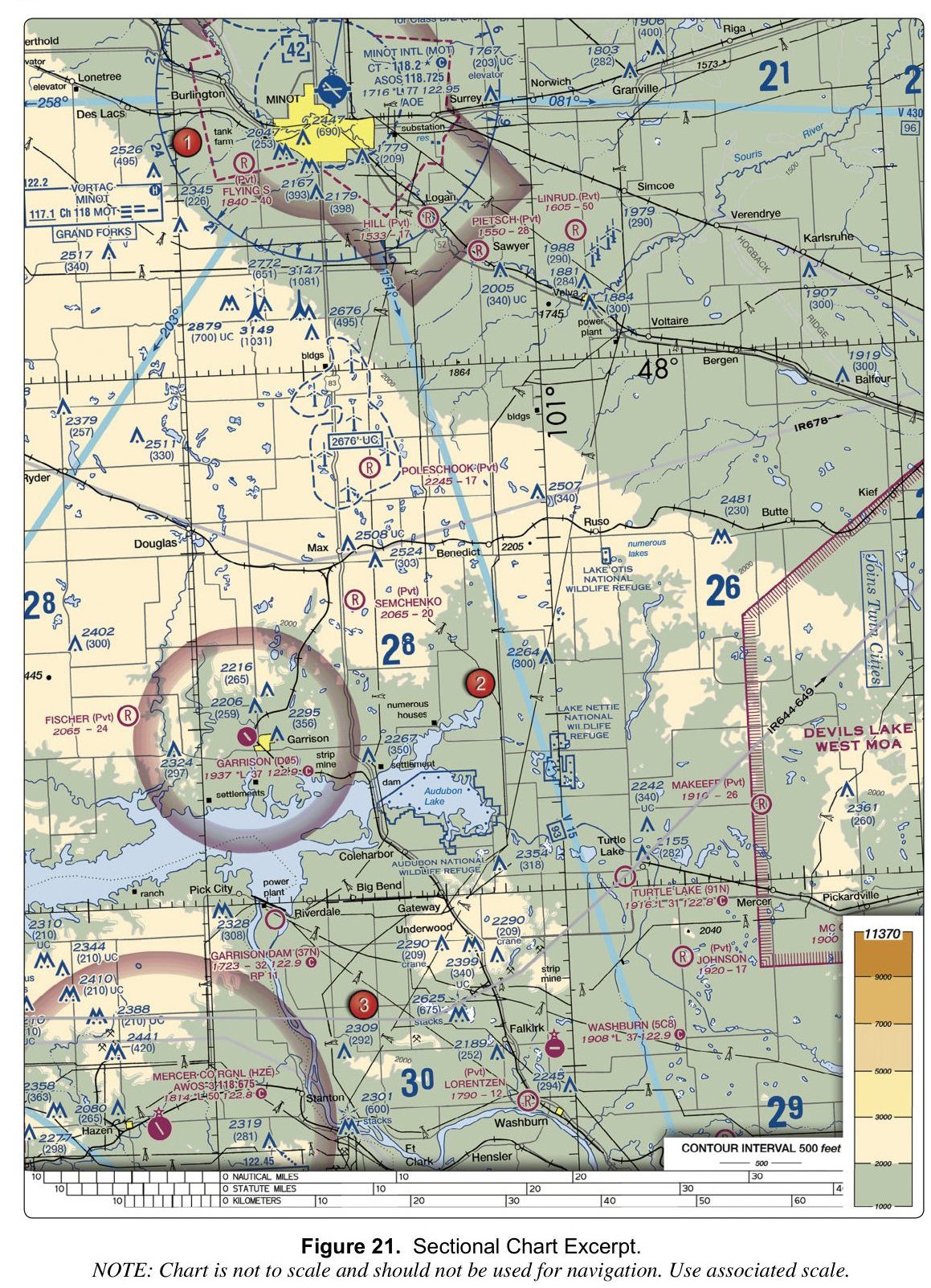
27. (Refer to FAA-CT-8080-2H, Figure 21.) What is the CTAF for Minot Intl (MOT)?
Figure 21 — Sectional chartOpen reference image
From the FAA testing supplement (FAA-CT-8080-2H). Tap the image to open it full size.
In the Minot Intl (MOT) data block, 'CT - 118.2' is the control tower frequency. The star means the tower operates part-time, and the C in a circle after it means 118.2 is also the CTAF when the tower is closed. 118.725 is the ASOS weather frequency on the next line. 122.9 is the CTAF at other airports on the chart, such as Garrison Dam and Washburn.
Airspace
28. (Refer to FAA-CT-8080-2H, Figure 22.) What is the field elevation of Magee (S77)?
Figure 22 — Sectional chartOpen reference image
From the FAA testing supplement (FAA-CT-8080-2H). Tap the image to open it full size.
On the chart, the Magee (S77) airport entry prints an elevation of 3002, which is the field elevation in feet MSL. The value 2,702 is the elevation of Carlin Bay (Pvt), and 2,880 is the elevation of Sky Island (Pvt), both nearby airports on the same chart. Locate the S77 identifier and read the elevation figure printed alongside it to confirm 3,002 feet MSL.
Airspace
29. A remote pilot intends to operate a small UAS within Class D airspace. What must the remote pilot do before beginning the operation?
Class D is controlled airspace, and Part 107 requires ATC authorization before you fly there. Drone pilots get it through LAANC, which gives near-real-time approval at participating airports, or by applying through FAA DroneZone; you do not call the tower to get it. A flight plan is not part of the process, and a waiver is not needed because authorization, not a waiver, is what airspace access requires.
Weather
30. A remote pilot in command is planning a small UA operation. The current METAR reports visibility of 10 SM and a ceiling of 5,000 feet. Which statement is most accurate?
Part 107 does not impose specific minimum visibility or ceiling requirements the way Part 91 does for VFR flight. The controlling requirement is Part 107, which mandates that the remote pilot in command must be able to see the small UA with unaided vision at all times. If the pilot can see the UA, the operation may proceed regardless of the METAR values. There is no 3 SM / 3,000 ft minimum in Part 107, and no waiver for weather minimums is needed because no such minimums exist in this rule.
Regulations
31. What must a remote pilot do when conducting operations under a Part 107 waiver?
Part 107 requires that a remote pilot have all the necessary paperwork if requested andPart 107 make a written waiver necessary (or have it accessible on a portable electronic device) at the time of operations conducted under the waiver. There is no requirement to file a copy with the FSDO before each flight, and there is no requirement to display the waiver number on the UAS.
Airspace
32. Which of the following airspace classes does NOT require ATC authorization for small unmanned aircraft operations under Part 107?
Part 107 lists only Class B, Class C, and Class D airspace as requiring ATC authorization for sUAS operations. Class G is uncontrolled airspace and does not appear in that list, so no ATC authorization is needed. Class D and Class B are both explicitly included in thePart 107 requirement, making them incorrect choices.
Airspace
33. Under Part 107, what must a remote pilot in command obtain before operating a small unmanned aircraft in Class C airspace?
Part 107 explicitly requires that a remote pilot in command must obtain an ATC authorization prior to operating a small unmanned aircraft in Class B, Class C, or Class D airspace. A waiver is not the mechanism for gaining access to controlled airspace under this rule, and filing a flight plan with a FSS is not a requirement for sUAS operations under Part 107, You can request authorization through the FAA via an automated system (e.g., approved LAANC service).
Regulations
34. The FAA registration for a small unmanned aircraft is valid for:
FAA registration of a small unmanned aircraft is valid for 3 years from the date of registration. After that period, the registration must be renewed to remain in compliance. The first option is wrong because the validity period is longer than one year. The third option is wrong because registration does not persist indefinitely; it has a fixed expiration of 3 years regardless of whether the aircraft is modified or not.
Regulations
35. Part 107 regulations apply to small unmanned aircraft that weigh:
Part 107 covers small unmanned aircraft weighing less than 55 lb, and it sets no minimum weight: a 100-gram drone flown for work is still a Part 107 operation, and it must still be registered. The 0.55 lb (250 g) figure people remember is a registration exemption for recreational flyers only, not a limit on Part 107. The first option is wrong for that reason. The third option describes aircraft too heavy to be small unmanned aircraft at all.
Airspace
36. Class D airspace typically extends from the surface to what altitude?
Class D airspace is defined as extending from the surface to 2,500 feet AGL. A remote pilot operating in this airspace must obtain ATC authorization under the ACS. Ten thousand feet MSL is the upper limit of Class B airspace, and 5,000 feet AGL is not a standard upper limit for any common airspace class. Knowing the vertical extent of Class D helps the remote pilot determine whether their planned altitude falls within controlled airspace requiring authorization.
Weather
37. Which of the following best describes the effect of cold ambient temperatures on a small UA's lithium-ion battery during flight?
Cold temperatures increase the internal resistance of lithium-ion cells, which reduces available capacity and causes greater voltage sag under load. This results in shorter flight times and can trigger low-voltage cutoffs earlier than expected. This is a well-established characteristic of lithium-ion chemistry. The battery does not produce higher voltage in the cold, and being fully charged before flight does not negate the reduced capacity available in cold conditions. A remote pilot in command must account for this when planning operations in cold weather.
Airspace
38. (Refer to FAA-CT-8080-2H, Figure 26.) What is the Common Traffic Advisory Frequency (CTAF) listed for Tomlinson (8J7)?
Figure 26 — Sectional chartOpen reference image
From the FAA testing supplement (FAA-CT-8080-2H). Tap the image to open it full size.
On the chart, the Tomlinson (8J7) airport entry shows the CTAF listed as 122.9. The value 118.425 is the ASOS frequency for Jamestown RGNL (JMS), and 118.725 is the AWOS-3 frequency for Barnes Co. (BAC). These are weather-broadcast frequencies, not CTAF values, and belong to different airports.
Airspace
39. (Refer to FAA-CT-8080-2H, Figure 59.) What is the tower frequency for Toledo Express Airport (TOL)?
Figure 59 — Sectional chartOpen reference image
From the FAA testing supplement (FAA-CT-8080-2H). Tap the image to open it full size.
In the Toledo Express (TOL) data block, 'CT - 118.1' is the control tower frequency. 118.75 is the ATIS frequency printed after it, and 118.375 is the ASOS frequency at Lenawee Co (ADG), a different airport on the chart.
Operations
40. When a visual observer is used during a Part 107 operation, which of the following is required?
Part 107 explicitly states that a visual observer must be able to communicate directly with the remote pilot. The regulation does not require the visual observer to hold a remote pilot certificate (eliminating option A), nor does it require the visual observer to be located at the remote pilot station (eliminating option C). The visual observer can be positioned anywhere that allows them to see the unmanned aircraft and maintain direct communication with the remote pilot.
Operations
41. Which of the following statements about a visual observer under Part 107 is correct?
Part 107 does not require a visual observer to hold any certificate or complete any specific test. The regulation only requires that the visual observer be capable of observing the unmanned aircraft to help the remote pilot comply with the visual line-of-sight requirement and be able to communicate directly with the remote pilot. Options A and B impose certification requirements that are not found in the regulation.
Regulations
42. Under Category 1, 2 or 3, when may a small drone be flown over people inside moving vehicles?
Since 2021 Part 107 allows flight over moving vehicles in Categories 1 to 3 when the drone meets its category's requirements and either stays within or over a closed- or restricted-access site with everyone in the vehicles on notice, or does not maintain sustained flight over the moving vehicles. A waiver is needed only for operations outside those conditions, and vehicle speed is not a factor in the rule.
Weather
43. Which of the following is the FAA's primary source of aviation weather information for remote pilots?
The FAA's own training materials and the Airman Certification Standards identify the Aviation Weather Center (AWC) at aviationweather.gov as the primary source of aviation weather information for remote pilots. This portal provides METARs, TAFs, PIREPs, and other aviation-relevant weather products in a format tailored to aviation users. While NOAA does produce weather data, the FAA directs remote pilots to its own AWC portal. NOTAMs may reference weather-related restrictions but are not a weather information source.
Operations
44. What additional requirement must a remote pilot satisfy before operating a small unmanned aircraft at night under Part 107?
Part 107 requires the remote pilot to have completed initial or recurrent training that includes the requirements for night operations. There is no regulatory requirement for a visual observer to be present during night operations (eliminating option B), and there is no requirement for the operation to be within visual line of sight of a control tower (eliminating option C).
Operations
45. What is the defined role of a visual observer?
Part 107 defines a visual observer as a person who is capable of observing the unmanned aircraft in order to help the remote pilot comply with the visual line-of-sight requirement of Part 107(a). The visual observer does not hold equal authority as a second remote pilot (eliminating option A), and monitoring battery status is not the defined regulatory role of a visual observer (eliminating option C).
Airspace
46. Which of the following airspace classes does NOT require an ATC airspace authorization for a remote pilot to operate a small unmanned aircraft?
Part 107 specifically lists Class B, Class C, Class D, and Class E (with a surface area) as the airspace classes requiring an ATC airspace authorization. Class G is uncontrolled airspace and is not included in this list, so no authorization is needed. Class E with a surface area and Class D are both explicitly listed in the regulation and do require authorization.
Loading and performance
47. What determines the maximum takeoff weight of a small unmanned aircraft system (sUAS)?
The maximum takeoff weight of an sUAS is established by the manufacturer and documented in the operating manual or specifications. Part 107 does not prescribe a universal maximum takeoff weight; it applies to sUAS of 55 lb or less, but the specific maximum for each aircraft is set by the manufacturer. The remote pilot must not exceed the manufacturer's stated maximum, but does not independently determine it. Weather conditions affect performance but do not change the maximum takeoff weight limit.
Airspace
48. Which of the following airspace classes is uncontrolled?
Class G airspace is the only uncontrolled airspace class in the United States. No ATC services are provided, and no authorization from air traffic control is required for small UAS operations. Class E airspace, while it may not have a control tower, is still classified as controlled airspace and, when designated from the surface, requires authorization for sUAS operations. Class D airspace surrounds towered airports and is controlled airspace requiring ATC authorization for sUAS operations.
Regulations
49. Which of these counts as sustained flight over an open-air assembly of people?
Sustained flight includes hovering above people in the assembly, flying back and forth over it, or circling so that the drone stays above some part of it. A brief, one-time transit that is merely incidental to a point-to-point flight unrelated to the gathering is not sustained flight, and flying beside the crowd is not flight over it at all.