The FAA published this sample set in August 2021. Our answers were checked against the current regulations and against the testing-supplement figures in September 2026.
Your answers are saved in this browser only.
0 of 46 answered
Weather
1. What are characteristics of a moist, unstable air mass?
Unstable air rises readily, building cumulus clouds that bring turbulence and showers. Visibility is usually good outside the showers. Smooth air, haze and smoke are signs of stable air. Link to this question
Regulations
2. According to 14 CFR part 107, how may a remote pilot operate an unmanned aircraft in Class C airspace?
Class B, C, D and surface-area Class E airspace all need ATC authorization before you fly, normally obtained through LAANC or DroneZone. Monitoring or calling ATC after launch does not satisfy it. Link to this question
Airspace
3. According to 14 CFR part 107 the remote pilot in command (PIC) of a small unmanned aircraft planning to operate within Class C airspace
Same rule as the previous question, asked differently: controlled airspace requires prior ATC authorization. No flight plan or visual observer is required. Link to this question
Weather
4. What effect does high density altitude have on the efficiency of a UA propeller?
High density altitude means thinner air. Each propeller revolution moves less air, so thrust and efficiency drop. Hot, high and humid conditions all raise density altitude. Link to this question
Operations
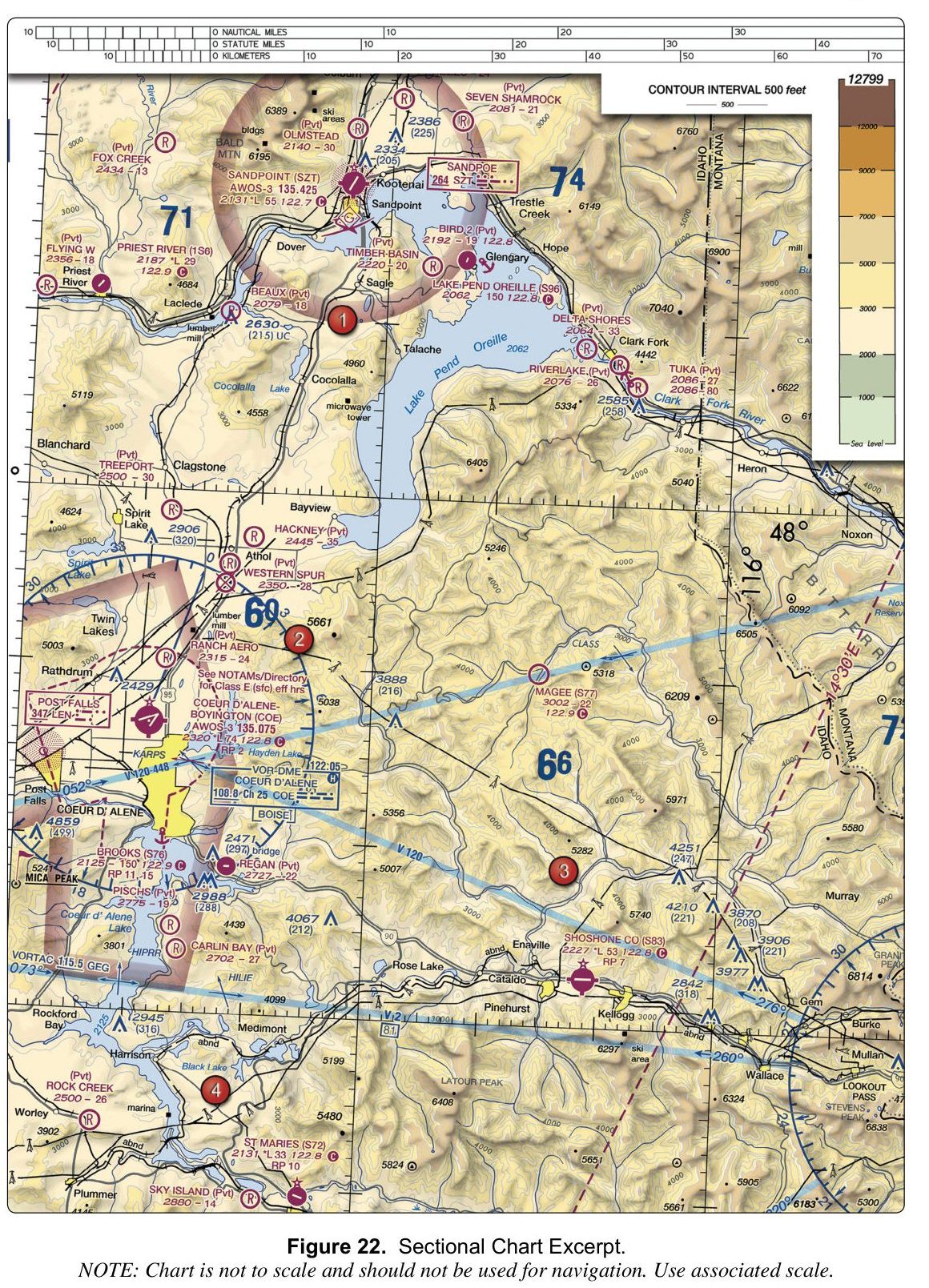
5. (Refer to FAA-CT-8080-2H, Figure 22, area 2.) At Coeur D`Alene which frequency should be used as a Common Traffic Advisory Frequency (CTAF) to monitor airport traffic?
Show Figure 22, area 2
From the FAA testing supplement (FAA-CT-8080-2H). Tap the image to open it full size.
The CTAF is the frequency next to the C in a solid circle in the airport data block, 122.8 at Coeur d'Alene. 135.075 is the AWOS weather frequency, not a traffic frequency. Link to this question
Regulations
6. Which technique should a remote pilot use to scan for traffic? A remote pilot should
The eye only sees detail when it stops and focuses, so scan in short pauses across segments of the sky. A continuous sweep sees very little, and a collision threat often shows no relative movement at all. Link to this question
Loading and performance
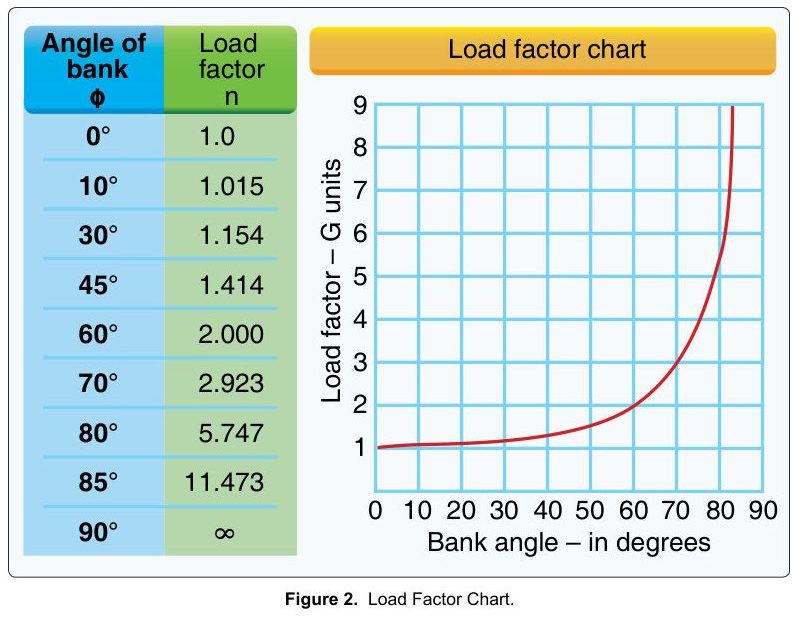
7. (Refer to FAA-CT-8080-2H, Figure 2.) If an unmanned airplane weighs 33 pounds, what approximate weight would the airplane structure be required to support during a 30° banked turn while maintaining altitude?
Show Figure 2
From the FAA testing supplement (FAA-CT-8080-2H). Tap the image to open it full size.
The load factor chart gives about 1.154 G in a level 30-degree bank. 33 x 1.154 is about 38 pounds. Link to this question
Airspace
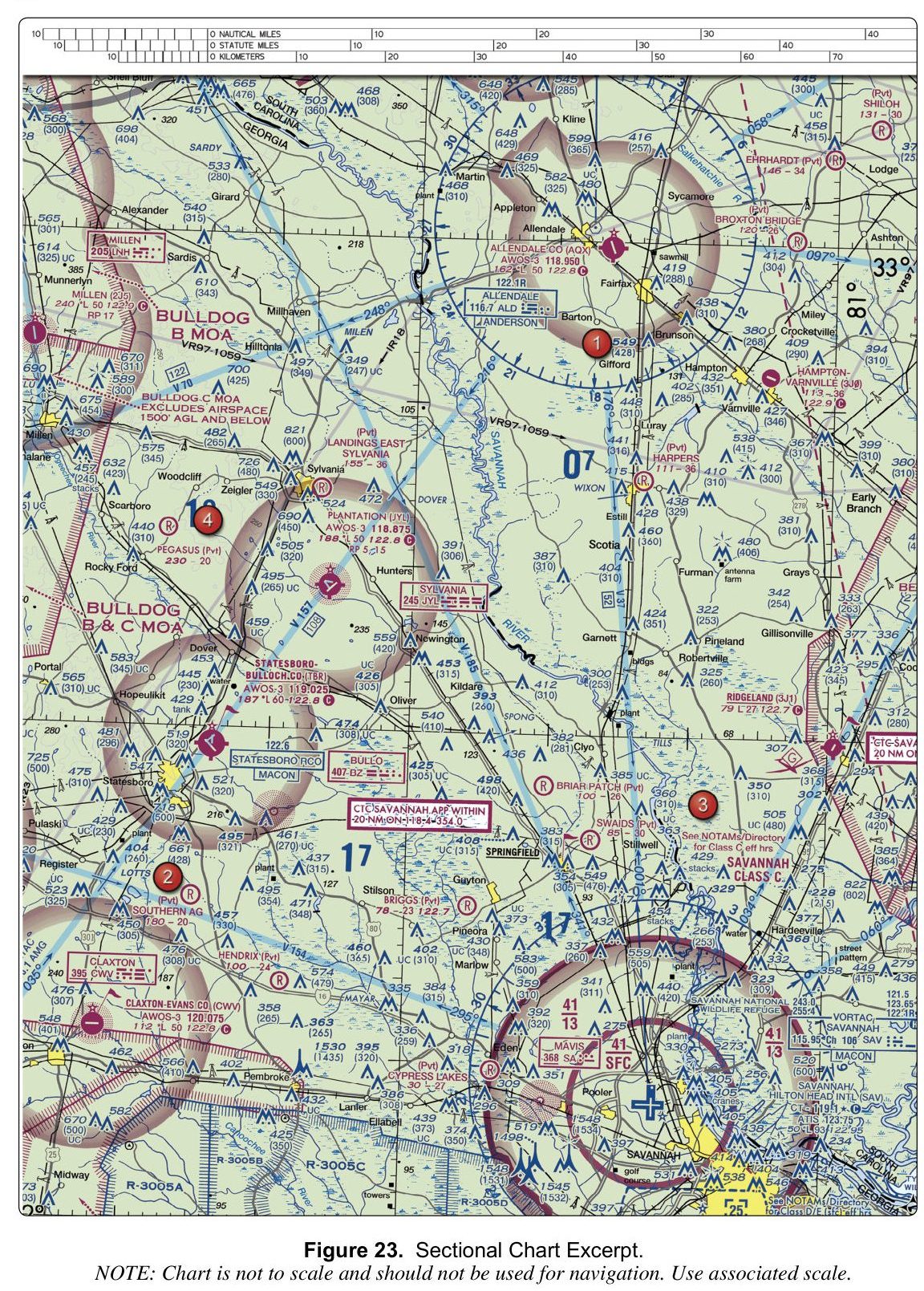
8. (Refer to FAA-CT-8080-2H, Figure 23, area 3.) What is the floor of the Savannah Class C airspace at the shelf area (outer circle)?
Show Figure 23, area 3
From the FAA testing supplement (FAA-CT-8080-2H). Tap the image to open it full size.
The outer ring is labelled 41 over 13: ceiling 4,100 feet, floor 1,300 feet. Altitudes on sectional charts are MSL unless marked otherwise. Link to this question
Operations
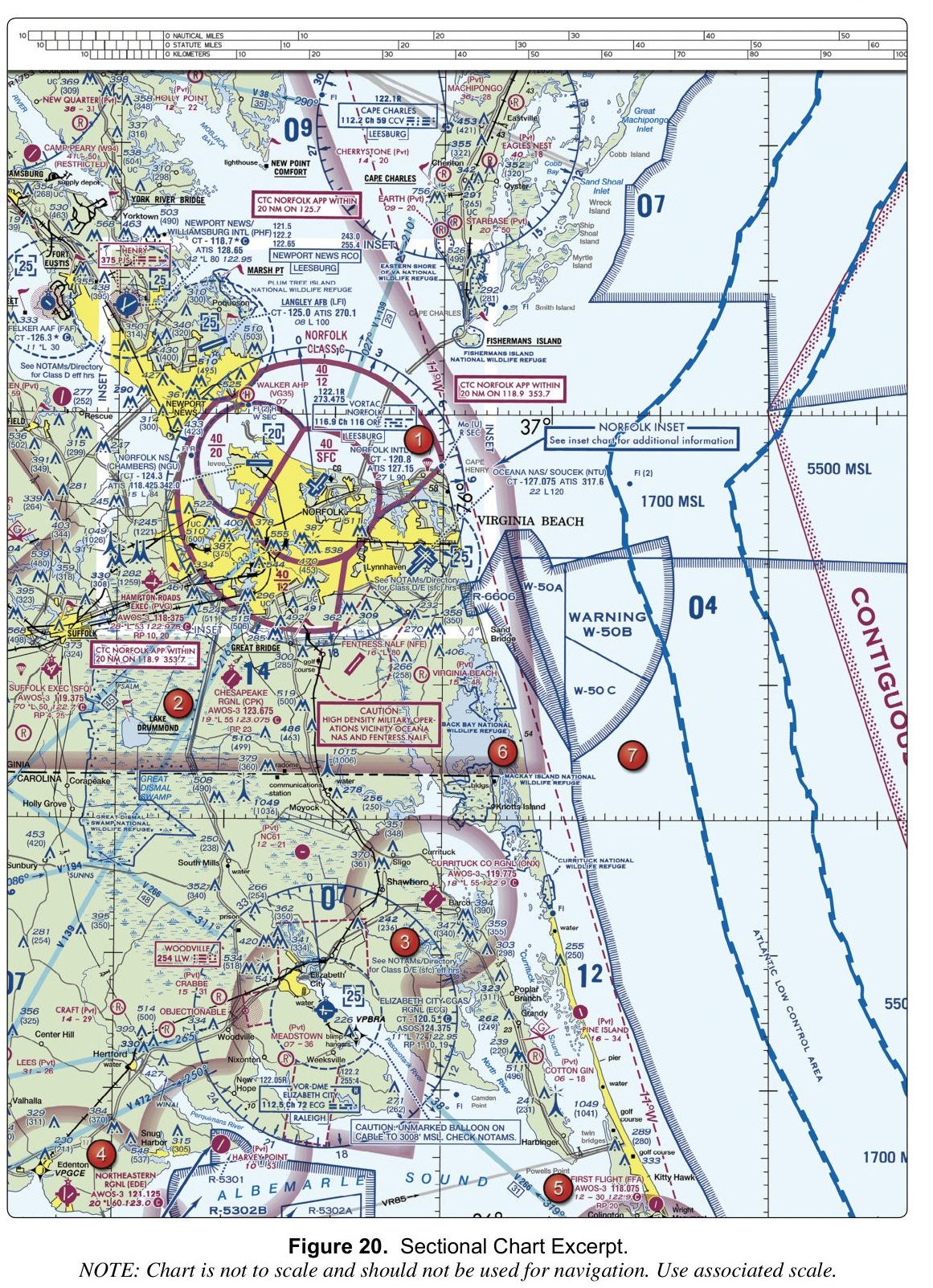
9. (Refer to FAA-CT-8080-2H, Figure 20, area 3.) With ATC authorization, you are operating your small unmanned aircraft approximately 4 SM southeast of Elizabeth City Regional Airport (ECG). What hazard is indicated to be in that area?
Show Figure 20, area 3
From the FAA testing supplement (FAA-CT-8080-2H). Tap the image to open it full size.
The chart note warns of an unmarked balloon on a cable to 3,008 feet. Chart altitudes are MSL unless stated as AGL. Link to this question
Airspace
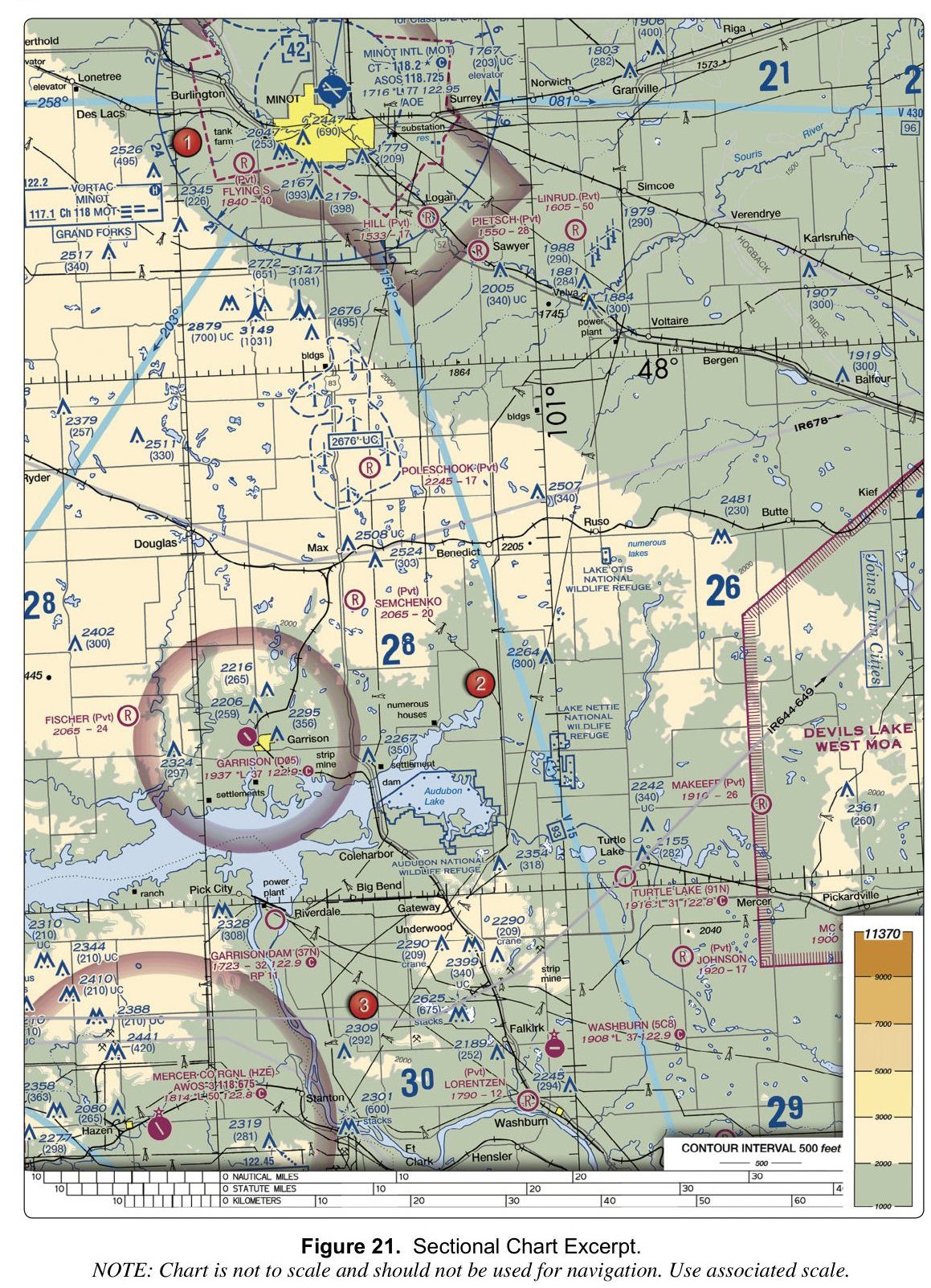
10. (Refer to FAA-CT-8080-2H, Figure 21.) You have been hired by a farmer to use your small UA to inspect his crops. The area that you are to survey is in the Devil`s Lake West MOA, east of area 2. How would you find out if the MOA is active?
Show Figure 21, area 2
From the FAA testing supplement (FAA-CT-8080-2H). Tap the image to open it full size.
Every sectional carries a special use airspace table in its legend margin listing each MOA's altitudes, times of use and controlling agency. The other two sources do not exist. Link to this question
Operations
11. The most comprehensive information on a given airport is provided by
The Chart Supplement has the full entry for each airport: runways, frequencies, services, remarks. NOTAMs cover temporary changes only; a TAC is a chart. Link to this question
Operations
12. Identify the hazardous attitude or characteristic a remote pilot displays while taking risks in order to impress others?
Taking risks to impress others is the macho attitude. The antidote is: taking chances is foolish. Link to this question
Operations
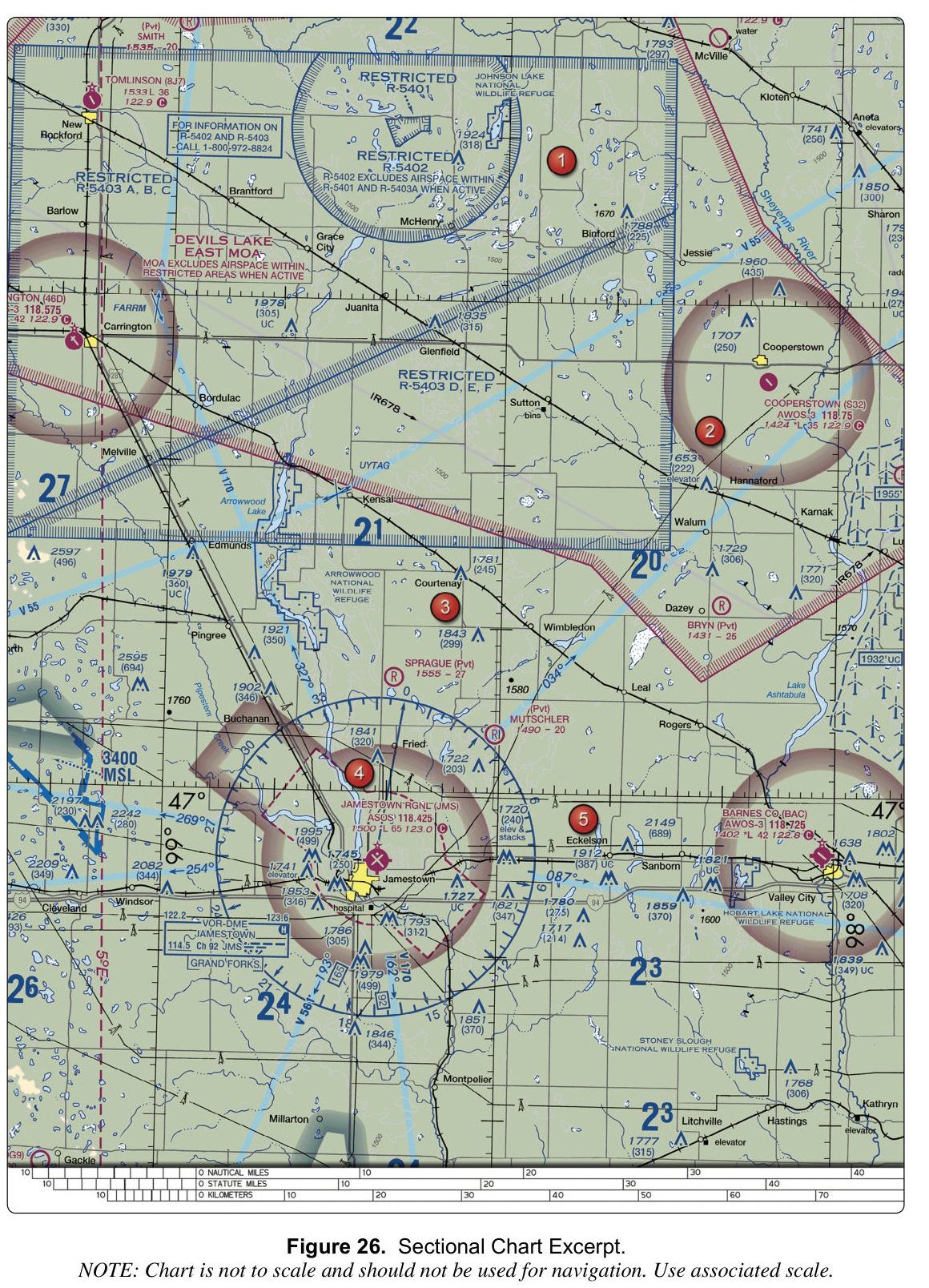
13. (Refer to FAA-CT-8080-2H, Figure 26, area 4.) You have been hired to inspect the tower under construction at 46.9N and 98.6W, near Jamestown Regional (JMS). What must you receive prior to flying your unmanned aircraft in this area?
Show Figure 26, area 4
From the FAA testing supplement (FAA-CT-8080-2H). Tap the image to open it full size.
The tower sits inside the dashed magenta line around Jamestown, Class E airspace that begins at the surface. Controlled airspace from the surface up needs ATC authorization. Link to this question
Airspace
14. (Refer to FAA-CT-8080-2H, Figure 20, area 5.) How would a remote PIC "CHECK NOTAMS" as noted in the CAUTION box regarding the unmarked balloon?
Show Figure 20, area 5
From the FAA testing supplement (FAA-CT-8080-2H). Tap the image to open it full size.
NOTAMs come through a flight service briefing, and 1800wxbrief.com is the FAA's online flight service. B4UFLY shows airspace advisories but is not the official NOTAM source the question is after. Link to this question
Operations
15. When adapting crew resource management (CRM) concepts to the operation of a small UA, CRM must be integrated into
CRM covers planning, preflight, flight and post-flight: every phase in which the crew has to work together. Link to this question
Operations
16. You have been hired as a remote pilot by a local TV news station to film breaking news with a small UA. You expressed a safety concern and the station manager has instructed you to `fly first, ask questions later.` What type of hazardous attitude does this attitude represent?
Acting first and thinking later is impulsivity. The antidote is: not so fast, think first. Link to this question
Operations
17. A local TV station has hired a remote pilot to operate their small UA to cover news stories. The remote pilot has had multiple near misses with obstacles on the ground and two small UAS accidents. What would be a solution for the news station to improve their operating safety culture?
A safety culture fixes the cause: recognise the hazardous attitudes and situations and write procedures around them. Accepting a quota of crashes, or accepting them as unavoidable, fixes nothing. Link to this question
Operations
18. (Refer to FAA-CT-8080-2H, Figure 26, area 2.) While monitoring the Cooperstown CTAF you hear an aircraft announce that they are midfield left downwind to RWY 13. Where would the aircraft be relative to the runway?
Show Figure 26, area 2
From the FAA testing supplement (FAA-CT-8080-2H). Tap the image to open it full size.
Runway 13 points about 130 degrees, to the southeast. A left-hand pattern keeps the runway on the pilot's left, which puts the downwind leg on the northeast side of the runway, so the aircraft is east of it. Link to this question
Operations
19. To avoid a possible collision with a manned airplane, you estimate that your small UA climbed to an altitude greater than 600 feet AGL. To whom must you report the deviation?
In an in-flight emergency the remote PIC may deviate from the rules as needed, and must send a written report only if the FAA asks for one. There is no automatic report to ATC or the NTSB. Link to this question
Loading and performance
20. When operating an unmanned airplane, the remote pilot should consider that the load factor on the wings may be increased any time
Turns, pull-ups and turbulence all raise the load on the wings above 1 G. Only straight-and-level flight holds it at 1 G. Link to this question
Loading and performance
21. A stall occurs when the smooth airflow over the unmanned airplane`s wing is disrupted and the lift degenerates rapidly. This is caused when the wing
A wing stalls when it exceeds its critical angle of attack, at any airspeed, attitude or weight. Link to this question
Operations
22. Safety is an important element for a remote pilot to consider prior to operating an unmanned aircraft system. To prevent the final "link" in the accident chain, a remote pilot must consider which methodology?
Risk management is the pilot's process of identifying hazards and breaking the chain of events before it ends in an accident. Link to this question
Operations
23. You are a remote pilot for a co-op energy service provider. You are to use your UA to inspect power lines in a remote area 15 hours away from your home office. After the drive, fatigue impacts your abilities to complete your assignment on time. Fatigue can be recognized
Fatigue impairs judgement much as alcohol does, and the person affected is often the last to notice. Experience does not make it easy to spot, and sleep loss cannot be willed away. Link to this question
Operations
24. (Refer to FAA-CT-8080-2H, Figure 21.) What airport is located approximately 47 (degrees) 40 (minutes) N latitude and 101 (degrees) 26 (minutes) W longitude?
Show Figure 21
From the FAA testing supplement (FAA-CT-8080-2H). Tap the image to open it full size.
Find 47 degrees 40 minutes north on the side scale and 101 degrees 26 minutes west on the top scale. They cross at Garrison. Link to this question
Weather
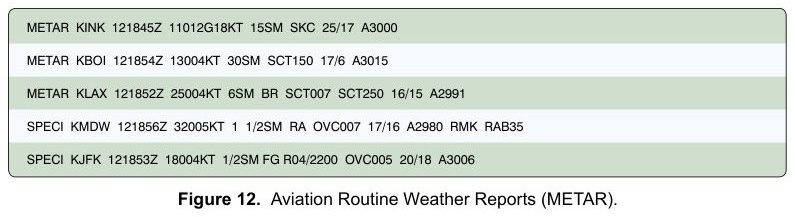
25. (Refer to FAA-CT-8080-2H, Figure 12.) What are the current conditions for Chicago Midway Airport (KMDW)?
Show Figure 12
From the FAA testing supplement (FAA-CT-8080-2H). Tap the image to open it full size.
The KMDW report (a SPECI, an unscheduled METAR) reads 1 1/2SM RA OVC007. Cloud heights are in hundreds of feet, so OVC007 is overcast at 700 feet. RA without a plus sign is moderate rain, not heavy. Link to this question
Weather
26. (Refer to FAA-CT-8080-2H, Figure 12.) The wind direction and velocity at KJFK is from
Show Figure 12
From the FAA testing supplement (FAA-CT-8080-2H). Tap the image to open it full size.
18004KT means from 180 degrees at 4 knots. Winds in a METAR are referenced to true north. Link to this question
Regulations
27. According to 14 CFR part 107, what is required to operate a small UA within 30 minutes after official sunset?
During civil twilight, the 30 minutes before sunrise and after sunset, the aircraft needs anti-collision lighting visible for 3 statute miles. Drones may not use transponders under Part 107 without FAA authorization. Link to this question
Loading and performance
28. To ensure that the unmanned aircraft center of gravity (CG) limits are not exceeded, follow the aircraft loading instructions specified in the
Loading limits are specific to the aircraft, so they come from its own manual. The AIM and the Weight and Balance Handbook are general references. Link to this question
Regulations
29. According to 14 CFR part 107, who is responsible for determining the performance of a small unmanned aircraft?
The remote PIC is directly responsible for the operation, which includes knowing the aircraft's performance in the conditions of that flight. Link to this question
Airspace
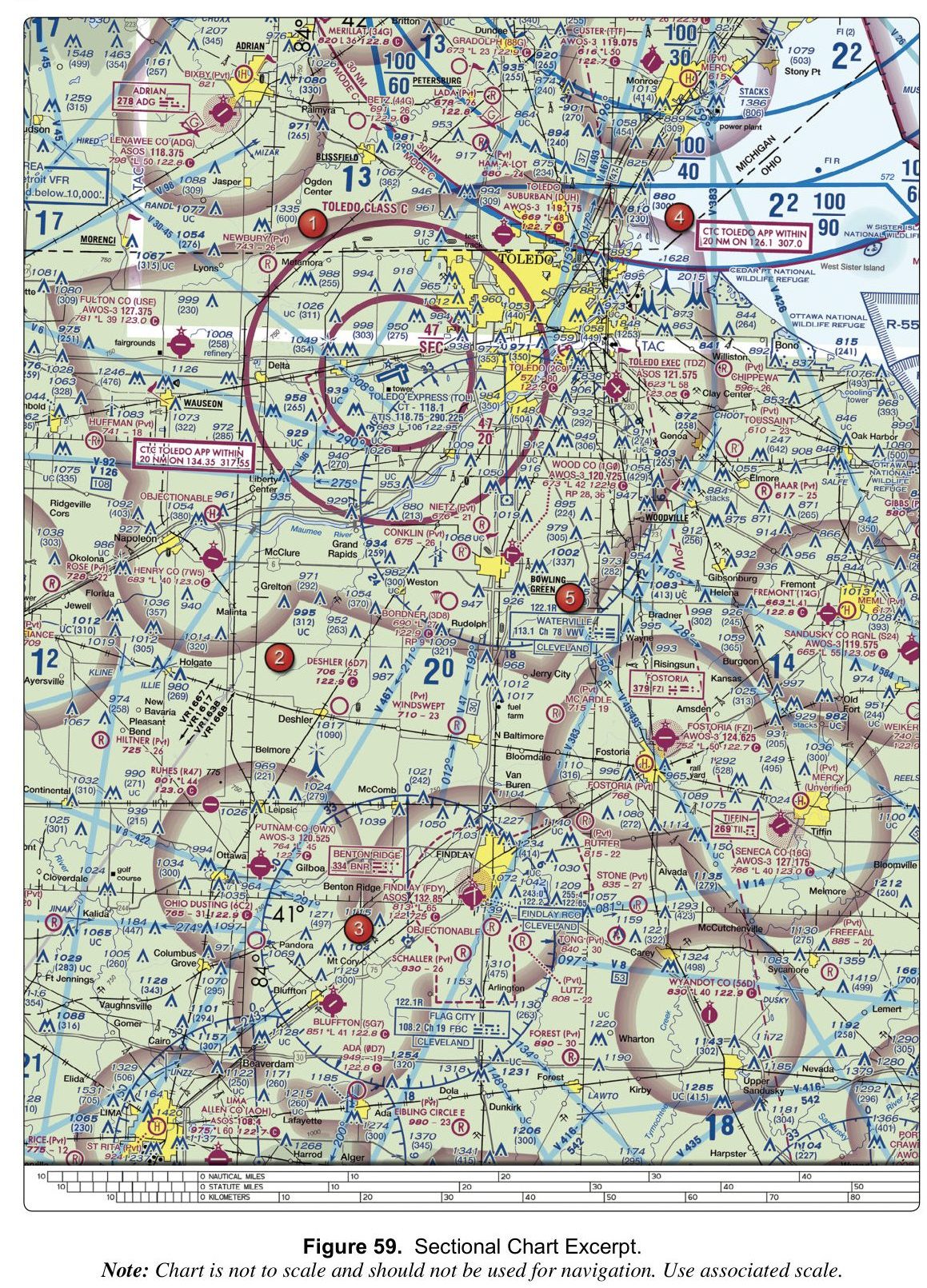
30. (Refer to FAA-CT-8080-2H, Figure 59, area 2.) The chart shows a gray line with "VR1667, VR1617, VR1638, and VR1668." Could this area present a hazard to the operations of a small UA?
Show Figure 59, area 2
From the FAA testing supplement (FAA-CT-8080-2H). Tap the image to open it full size.
These are military training routes. A four-digit number means the route is flown at or below 1,500 feet AGL, which puts fast military jets down where drones fly. Link to this question
Operations
31. (Refer to FAA-CT-8080-2H, Figure 26.) What does the line of latitude at area 4 measure?
Show Figure 26, area 4
From the FAA testing supplement (FAA-CT-8080-2H). Tap the image to open it full size.
Latitude measures north and south of the equator. East and west of the Prime Meridian, which runs through Greenwich, is longitude. Link to this question
Operations
32. Under what condition should the operator of a small UA establish scheduled maintenance protocol?
Follow the manufacturer's schedule. If there isn't one, set up your own, so the aircraft is kept in a condition for safe operation. Link to this question
Operations
33. According to 14 CFR part 107, the responsibility to inspect the small UAS to ensure it is in a safe operating condition rests with the
Before every flight, the remote PIC must check that the aircraft is in a condition for safe operation. Link to this question
Regulations
34. According to 14 CFR part 48, when would a small UA owner not be permitted to register it?
You must be at least 13 to register. A younger owner's drone has to be registered by someone 13 or older. No driver's licence is needed. Link to this question
Regulations
35. According to 14 CFR part 48, when must a person register a small UA with the Federal Aviation Administration?
Anything over 0.55 pounds (250 g) must be registered whatever it is used for. Under that weight, only drones flown recreationally are exempt; a sub-250 g drone flown under Part 107 still has to be registered. Link to this question
Operations
36. Which is true regarding the presence of alcohol within the human body?
Even small amounts of alcohol impair judgement. The body clears alcohol at a fixed rate that water, coffee and exercise do not change. Link to this question
Operations
37. When using a small UA in a commercial operation, who is responsible for briefing the participants about emergency procedures?
Before flight the remote PIC must make sure everyone involved in the operation knows the operating conditions, emergency procedures, contingency procedures, roles and hazards. Link to this question
Stable air resists vertical movement, so haze and pollutants stay trapped near the ground and clouds form in flat layers that give steady precipitation. Link to this question
Weather
39. You have received an outlook briefing from flight service through 1800wxbrief.com. The briefing indicates you can expect a low-level temperature inversion with high relative humidity. What weather conditions would you expect?
An inversion is very stable air. The air stays smooth, but moisture and haze are trapped beneath it, giving fog, haze or low cloud. Link to this question
Regulations
40. When may a remote pilot reduce the intensity of an aircraft’s lights during a night flight?
The remote PIC may dim the anti-collision lights if doing so is in the interest of safety, for example to avoid dazzling people nearby. Link to this question
Regulations
41. What must a person, who is manipulating the controls of a small unmanned aircraft, do if the standard remote identification fails during a flight?
If Remote ID stops broadcasting in flight, the aircraft must be landed as soon as practicable. Link to this question
Regulations
42. Where must a small unmanned aircraft’s serial number be listed when using either standard remote identification or a broadcast module?
The Remote ID serial number, of the aircraft or of the broadcast module, goes on your registration in DroneZone and appears on the Certificate of Aircraft Registration. A declaration of compliance is the manufacturer's document, not yours, and for a broadcast module it lists the module's serial number, not the aircraft's, so it can't be the answer for both cases. Link to this question
Operations
43. When preparing for a night flight, what should an sUAS pilot be aware of after assembling and conducting a preflight of an aircraft while using a bright flashlight or work light?
Full dark adaptation takes about 30 minutes, and one exposure to bright light can undo it. A dim red light preserves night vision far better than a bright white one. Link to this question
Regulations
44. To conduct Category 1 operations, a remote pilot in command must use a small unmanned aircraft that weighs
Category 1 covers aircraft of 0.55 pounds (250 g) or less, including everything on board at takeoff, with no exposed rotating parts that could lacerate skin. Link to this question
Regulations
45. Which Category of small unmanned aircraft must have an airworthiness certificate issued by the FAA?
Category 4 aircraft need an FAA airworthiness certificate. Categories 2 and 3 instead rely on a manufacturer's declaration of compliance. Link to this question
Airspace
46. Your surveying company is a title sponsor for a race team at the Indianapolis 500. To promote your new aerial surveying department, you decide to video part of the race using a small UA. The FAA has issued a Temporary Flight Restriction (TFR) for the race in the area you plan to fly. In this situation
A TFR applies to drones as much as to manned aircraft. Sponsorship and notifying spectators change nothing; only specific FAA authorization lets you fly inside it. Link to this question