⚙ Test optionslength, one at a time or all, study mode
Length10 · 25 · 50 · all 161✓ Progress saved on this device
Regulations
1. A recreational flyer owns a drone that weighs 200 grams and flies it exclusively for recreation. The flyer voluntarily registers the drone with the FAA. Which statement about Remote ID is correct?
Why: The FAA's published Remote ID guidance states that drones which are required to be registered or are registered, including those flown for recreation, business, or public safety, must comply with the Remote ID rule. Although a sub-250-gram recreational drone is not required to be registered, once the flyer voluntarily registers it, the drone falls under the Remote ID requirement. The rule is triggered by registration status, not by the type of pilot certificate held, so the option tying compliance to a Part 107 certificate is incorrect.
2. What are the minimum weather conditions for flying under Part 107?
Why: Part 107 sets its own weather minimums: flight visibility of at least 3 statute miles as seen from the control station, and a distance from clouds of at least 500 feet below and 2,000 feet horizontally. Keeping the aircraft in sight is a separate requirement, not a substitute for these. Both limits can be waived, but only with an approved waiver in hand.
3. A remote pilot purchases a new drone that the manufacturer states has 'Remote ID capability.' Before operating the drone in compliance with the Remote ID rule, what must the pilot verify?
Why: To comply with Remote ID, a standard Remote ID drone's serial number, or the broadcast module's serial number, must be listed on an FAA-accepted declaration of compliance (14 CFR 89.110(b), 89.115(a)). A manufacturer's claim of 'Remote ID capability' is not enough on its own; the pilot can check the FAA's list of accepted declarations. Waivers are issued to operators for Part 107 rules and have nothing to do with a drone's Remote ID acceptance, and the 55 lb figure only defines a small unmanned aircraft.
4. What is the minimum visibility distance required for anti-collision lighting when operating a small unmanned aircraft at night under Part 107?
Why: Part 107 requires anti-collision lighting visible for at least 3 statute miles that has a flash rate sufficient to avoid a collision (14 CFR 107.29). One and two statute miles do not meet that minimum.
5. A sectional chart shows a communications tower labeled 2150 (450). The drone will remain within 400 feet horizontally of the tower. Assuming the applicable airspace authorization and all other operating restrictions permit the operation, what is the highest altitude in MSL permitted by the Part 107 structure provision?
Why: The obstacle label shows the top of the tower at 2,150 feet MSL and about 450 feet above the surrounding ground. Under 14 CFR 107.51(b), a small UA may fly higher than 400 feet AGL when it stays within a 400-foot radius of a structure and no more than 400 feet above the structure's immediate uppermost limit: 2,150 + 400 = 2,550 ft MSL. The 2,100 ft option is 400 ft above the ground (1,700 + 400), which ignores the structure provision. The provision does not remove other requirements: in controlled airspace the operation must also comply with the altitude and conditions of the airspace authorization.
6. Under Part 107, without a waiver of the moving-vehicle rule, under what circumstances may a remote pilot operate a small unmanned aircraft from a moving land or water-borne vehicle?
Why: Without an FAA waiver of the moving-vehicle rule, operation from a moving land or water-borne vehicle is permitted only over a sparsely populated area and must not involve transporting another person's property for compensation or hire. Operation from a moving aircraft also requires an FAA waiver. A waiver of this rule cannot authorize transporting another person's property for compensation or hire. The rule does not set a 25 mph vehicle-speed threshold. An airspace authorization does not substitute for a waiver of the moving-vehicle rule.
7. A drone operator conducting aeronautical research needs FAA authority to operate without Remote ID equipment. What is the appropriate mechanism?
Why: The FAA may issue a Remote ID Letter of Authorization (LOA) allowing eligible operators to operate without Remote ID or otherwise deviate from Remote ID requirements. FAA guidance specifically identifies aeronautical research and demonstrations of regulatory compliance as purposes for which a Remote ID LOA may be issued (14 CFR 89.120). Remote ID requirements are contained in 14 CFR Part 89, so they are not simply waived through the ordinary Part 107 operational-waiver process. There is also no special aircraft registration category that automatically produces the exemption described in the question.
8. A METAR reports: KJFK 251755Z 36012KT 1/2SM BR OVC005 M02/M04 A2992. What does 1/2SM mean?
Why: In a U.S. METAR, prevailing visibility is reported in statute miles, indicated by the suffix SM. Therefore, 1/2SM means a prevailing visibility of one-half statute mile. For Part 107 operations, the regulatory minimum flight visibility is 3 statute miles as observed from the control station. Consequently, if the flight visibility at the control station were also one-half statute mile, the normal Part 107 visibility requirement would not be met.
9. A remote pilot intends to operate three small unmanned aircraft under Part 107. Which statement about registration is correct?
Why: Part 107 operators must register each individual device separately, and each device is assigned a unique registration number. This differs from recreational registration, where a single registration number can be applied to all devices in the inventory. The same make and model does not allow a Part 107 pilot to share a registration number across multiple aircraft, and the requirement applies to all registered devices, not only those with a broadcast module.
10. What is the defined role of a visual observer?
Why: A visual observer assists the remote pilot and the person manipulating the controls in seeing the aircraft and scanning for hazards. When used, the visual observer and other crew members must maintain effective communication and coordinate their observations. The remote pilot in command remains responsible for the operation; the visual observer does not have equal command authority. Monitoring battery status is not the defining role of a visual observer.
11. A county sheriff's department operates a registered drone for public safety missions. Which statement about Remote ID is correct?
Why: The Remote ID rule explicitly covers drones flown for public safety in addition to recreation and business, so a registered public safety drone must comply. The FAA does issue Remote ID Letters of Authorization to operators who are eligible to operate without Remote ID or to deviate from the requirements, such as for aeronautical research or to demonstrate compliance with regulations. The jurisdiction option is wrong because the rule applies regardless of where the operation takes place; there is no geographic carve-out tied to county lines. The blanket-exemption option is wrong because the rule does not carve out a general public safety exception.
12. A remote pilot plans a flight from a high-elevation site on a hot, humid afternoon. How will high density altitude affect the small unmanned aircraft?
Why: Heat, humidity and elevation all raise density altitude, meaning the air is less dense. Propellers and wings then produce less thrust and lift, so climb performance and payload capability decrease, and endurance may also decrease. This applies to multirotors as well as fixed-wing aircraft.
Source: FAA Remote Pilot Study Guide (FAA-G-8082-22)
13. An applicant fails the Part 107 Initial Aeronautical Knowledge Test. What is the minimum waiting period before the applicant may retake it?
Why: Under 14 CFR 107.71, an applicant who fails a knowledge test may not reapply for 14 calendar days. Do not confuse this with recurrent requirements: remote pilots no longer take a recurrent knowledge test, and certificate holders maintain aeronautical knowledge recency by completing the FAA's online recurrent training every 24 calendar months.
14. A Part 107 remote pilot is registering a drone that uses a Remote ID broadcast module rather than built-in Standard Remote ID. During the registration process, which information must the pilot enter for this device?
Why: For Part 107 pilots using a Remote ID broadcast module, the FAA instructions direct the pilot to list the drone's make/model while adding the broadcast module's Remote ID serial number. Each device in the Part 107 inventory is registered separately and assigned a unique registration number. The 'only the module's serial number' option omits the required drone make/model information. The 'drone's serial number' option is incorrect because the instruction specifically calls for the drone's make/model, not its serial number, when registering a broadcast module device under Part 107.
15. Which statement about Category 3 operations and open-air assemblies of people is correct?
Why: Under the standard rules, Category 3 drones may not fly over open-air assemblies of people. For Categories 1, 2 and 4, sustained flight over an open-air assembly requires the specified Remote ID compliance. A brief, one-time transit incidental to an unrelated point-to-point flight does not count as sustained flight. Neither provision permits Category 3 flight over an open-air assembly.
16. A remote pilot plans to fly approximately 8 statute miles from the airport for which a TAF has been issued. What should the pilot understand about the TAF's geographic coverage?
Why: A U.S. Terminal Aerodrome Forecast describes expected conditions within approximately 5 statute miles of the center of the airport's runway complex. A site 8 statute miles away is outside that area. The TAF is still useful context, but the pilot should not assume conditions at the site will match it. The 10-mile figure belongs to "vicinity" (VC) in observations, and a TAF's coverage is not tied to airspace boundaries.
17. Class D airspace typically extends from the surface up to about what height above the airport?
Why: Class D is usually a cylinder about 2,500 feet above the airport elevation, charted in MSL and rounded, with the exact figure on the sectional. 10,000 feet MSL is the typical top of Class B. Always read the chart for the airport you are flying near.
18. A remote pilot completed Part 107 recurrent training on March 10, 2025. Through what date may the pilot exercise remote pilot privileges without completing further training?
Why: Section 107.65 requires the applicable knowledge test or training within the previous 24 calendar months. Calendar months run to the end of the month, so training completed on March 10, 2025 keeps the pilot current through March 31, 2027.
19. A remote pilot has completed the updated recurrent training and plans a night operation. The drone is equipped with anti-collision lighting visible for at least 3 statute miles. Which statement is correct?
Why: Since the 2021 rule change, a waiver is not required for an otherwise compliant routine night operation when the remote pilot in command has satisfied the applicable initial knowledge test or training requirement under 14 CFR 107.65 and the aircraft has anti-collision lighting visible for at least 3 statute miles with a flash rate sufficient to avoid a collision (107.29). The light may be dimmed when the remote PIC determines that doing so is in the interest of safety, but it may not be extinguished. The 'waiver still required' option is wrong because routine night operations no longer depend on a waiver, and the 'full intensity at all times' option is wrong because the rule expressly allows the intensity to be reduced for safety.
20. A remote pilot is experiencing significant personal stress but believes they can still concentrate on the flight. Under the fitness-to-fly standard, what is the correct approach?
Why: The standard is functional: a pilot must not act as remote PIC or in any other required role when they know or have reason to know of a condition that would interfere with safe operation. It is not an absolute prohibition on all stress (which would make the 'must not fly' option wrong), nor is it satisfied merely by a pilot's belief that they can concentrate (which makes the 'may fly' option wrong). The correct approach is to make a deliberate determination about whether the specific stress is likely to interfere with safe operation, and if it is, the pilot should not fly.
21. A remote pilot is using a visual observer during a Part 107 operation. What is required regarding communication between the remote pilot and the visual observer?
Why: Section 107.33 requires the remote pilot in command, the person manipulating the controls and the visual observer to maintain effective communication with each other at all times. The regulation does not prescribe a particular communication technology, but whatever method the crew uses must actually keep communication effective throughout the operation. Requiring face-to-face contact adds a condition the rule does not contain, and communicating only when a hazard appears fails the at-all-times requirement.
22. Which of these counts as sustained flight over an open-air assembly of people?
Why: Sustained flight includes hovering above people in the assembly, flying back and forth over it, or circling so that the drone stays above some part of it. A single transit that is merely incidental to a point-to-point flight unrelated to the gathering is not sustained flight. Hovering beside the crowd, however long, is not flight over it at all.
23. With airspeed and available flight time unchanged, which wind condition reduces distance covered over the ground?
Why: At the same airspeed, a headwind reduces groundspeed and therefore the distance covered in a given flight time. Actual battery endurance depends on the aircraft and how it is operated; use its performance data.
24. Before a Part 107 flight with a visual observer, what must the remote pilot in command do?
Why: Section 107.49 requires the remote pilot in command, before flight, to ensure that all persons directly participating in the operation are informed about the operating conditions, emergency procedures, contingency procedures, roles and responsibilities, and potential hazards. That means every direct participant, not only the visual observer and the person on the controls, and no written record of the briefing is required.
25. A remote PIC delegates the preflight inspection to a visual observer. The visual observer completes the inspection and reports that everything looks good. The PIC then independently discovers a cracked landing gear strut. Under the rules, who bears the responsibility for ensuring the aircraft was in a condition for safe operation?
Why: Before each flight the remote pilot in command must check the small UAS to determine whether it is in a condition for safe operation (14 CFR 107.15), and the remote pilot in command is directly responsible for the operation (107.19). A visual observer can help with the inspection, but that does not move the responsibility: it stays with the remote pilot in command, not with the observer or shared equally.
26. During a routine Part 107 night operation, the required anti-collision light fails completely. What should the remote PIC do?
Why: Section 107.29 prohibits operating at night without lighted anti-collision lighting visible for at least 3 statute miles with a flash rate sufficient to avoid a collision, so an ordinary night operation cannot continue once the light fails: the pilot should terminate it and land as soon as practicable. Strictly, 107.29 does not use the words "land as soon as practicable" (that phrase is in the Remote ID rule, 89.110); the point is that continued night flight would no longer comply with 107.29. Navigation lights do not meet the anti-collision requirement, and flying lower is not an exception. If an actual in-flight emergency exists, 107.21 allows deviation from the rules to the extent necessary to meet it.
27. A METAR reports: KATL 261853Z 27012KT 8SM VCSH FEW035 SCT050 22/14 A3004. What does VCSH indicate?
Why: VC means in the vicinity, and SH means showers. Therefore, VCSH means showers are occurring near the airport but not at the observation point. For precipitation, U.S. METAR coding can report VCSH when precipitation is not occurring at the observation point but is observed within 10 statute miles. A METAR is an observation of current conditions; VCSH is not a forecast that showers will begin later.
28. A remote pilot holds a valid remote pilot certificate and a Part 107 waiver for operations from a moving vehicle. The waiver has an expiration date of June 30, 2027. The remote pilot's certificate has no expiration date. Which statement correctly describes the relationship between these two documents?
Why: A Part 107 waiver is a separate Certificate of Waiver, not a component of the remote pilot certificate. It carries its own validity period, specific operational conditions, and limitations that are independent of the pilot's certificate. The 'incorporated into the certificate' option is wrong because the waiver is a distinct document with its own expiration; it does not inherit the certificate's indefinite duration. The 'automatically renews' option is wrong because waivers do not auto-renew; a new application must be submitted when a waiver expires.
29. A remote pilot in command deviates from the maximum altitude rule during an emergency. Which statement about the scope of that authority is correct?
Why: The emergency deviation authority is expressly limited to the extent necessary to meet the emergency; it is not a blanket license to ignore all rules. The 'unlimited until operation complete' option overstates the authority, which is tied to the specific emergency, not to the remainder of the flight. The 'ATC approval first' option is wrong because the authority exists so the pilot can act at once, without prior approval; the FAA may ask for a written report afterward.
30. A remote pilot adds a heavy sensor package to a battery-powered multirotor small UA without changing its battery or propulsion system. What combination of performance changes is most likely?
Why: A heavier multirotor must generate more thrust just to hover. Producing that thrust takes more motor power, which leaves less power margin for climbing and drains the battery faster. Both climb performance and endurance therefore decrease when substantial payload is added without more propulsion power or battery capacity. The same battery does not give the same endurance, because the power drawn from it goes up, and climb rate cannot stay the same when more of the available thrust is used to carry the weight.
31. A LAANC request is approved with a ceiling of 300 feet. What does this ceiling value refer to?
Why: LAANC ceilings are expressed in feet above ground level, ranging from 0 to 400 feet, and are never stated in mean sea level. The MSL option is wrong because the LAANC system and the UAS facility map use AGL values exclusively; converting to MSL would require knowing the local terrain elevation, which varies by location and is not how the ceiling is defined. The airport field elevation option is wrong for the same reason: the ceiling is a generic AGL value applied to the ground surface, not a fixed offset from a specific airport elevation. Pilots must account for local terrain when determining the actual MSL altitude at which the 300 ft AGL ceiling is reached.
32. Before beginning a Part 107 operation, the remote pilot-in-command must ensure that every person directly participating in the operation has been briefed on what?
Why: Section 107.49 requires the remote PIC, before flight, to ensure that everyone directly participating is informed about the operating conditions, emergency and contingency procedures, roles and responsibilities, and potential hazards. Of the options, only assigned duties (roles) and emergency procedures come from that list. A 24-hour forecast and the exact lateral boundaries of the airspace belong to the remote PIC's own preflight assessment of the operating environment, not to the crew briefing.
33. Which of the following operations requires a Part 107 waiver?
Why: Under section 107.39 a small UAS may be flown over a person who is directly participating in the operation, or who is under a covered structure or inside a stationary vehicle that provides reasonable protection, without any category. Over anyone else, the aircraft and operation must meet Category 1, 2, 3 or 4; otherwise a waiver is required. Night flight with proper anti-collision lighting and a trained pilot is a standard operation, and so is flight in Class D airspace with prior authorization through LAANC or DroneZone; neither needs a waiver.
34. A remote pilot is operating a drone fitted with a Remote ID broadcast module. What requirement applies to this pilot during the flight?
Why: A drone using a Remote ID broadcast module is limited to visual-line-of-sight operations: the Remote ID rule requires the person manipulating the flight controls to be able to see the aircraft at all times throughout the operation (14 CFR 89.115(a)(2)(ii)). This is a condition of the broadcast-module method itself, separate from the general Part 107 visual-line-of-sight rule. A broadcast module transmits the drone's identification and location and its take-off location; Standard Remote ID transmits the control-station location instead.
35. A small unmanned aircraft that weighs 0.45 lb (approximately 204 grams) and is used for recreational flying is:
Why: A drone flown exclusively under the recreational exception does not require registration if it weighs less than 250 grams (0.55 lb), counting everything attached; at 250 grams or more, registration is required. This 204-gram drone flown only for recreation is therefore exempt. The threshold is 250 grams, not 0.25 lb, and not every drone must be registered: the exemption is for recreational flying only, and under Part 107 every drone must be registered whatever it weighs.
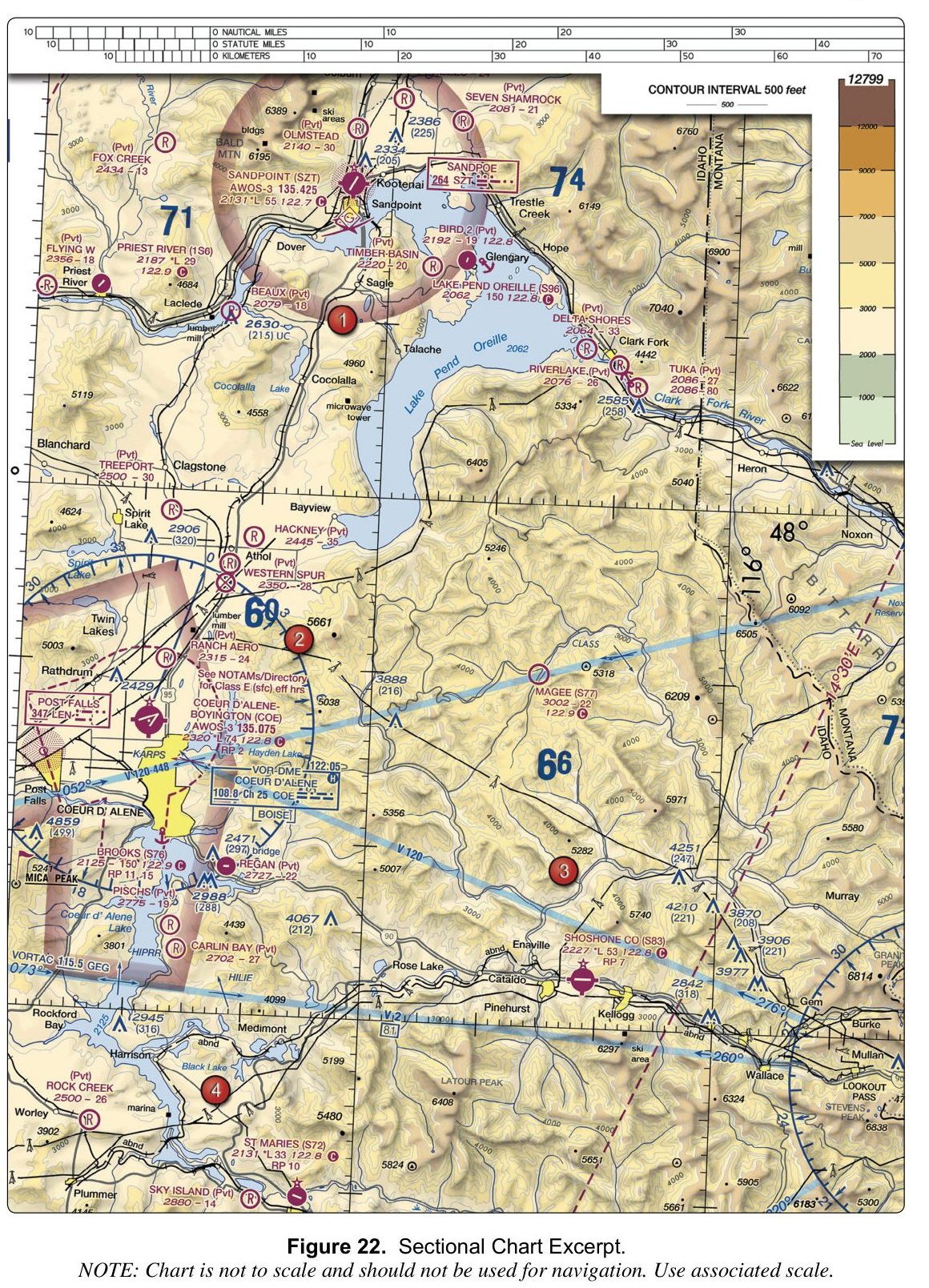
36. (Refer to FAA-CT-8080-2H, Figure 22.) What is the field elevation of Magee (S77)?
Figure 22 — Sectional chartOpen reference image
From the FAA testing supplement (FAA-CT-8080-2H). Tap the image to open it full size.
Why: On the chart, the Magee (S77) airport entry prints an elevation of 3002, which is the field elevation in feet MSL. The value 2,702 is the elevation of Carlin Bay (Pvt), and 2,880 is the elevation of Sky Island (Pvt), both nearby airports on the same chart. Locate the S77 identifier and read the elevation figure printed alongside it to confirm 3,002 feet MSL.
37. During a Part 107 operation, a manned helicopter appears and is flying toward the drone's area at low altitude. Which statement is correct?
Why: Section 107.37 requires the small unmanned aircraft to yield the right of way to all aircraft, airborne vehicles and launch and reentry vehicles, and not to pass so close to another aircraft as to create a collision hazard. Being there first, or the manned-aircraft right-of-way conventions, do not give the drone priority.
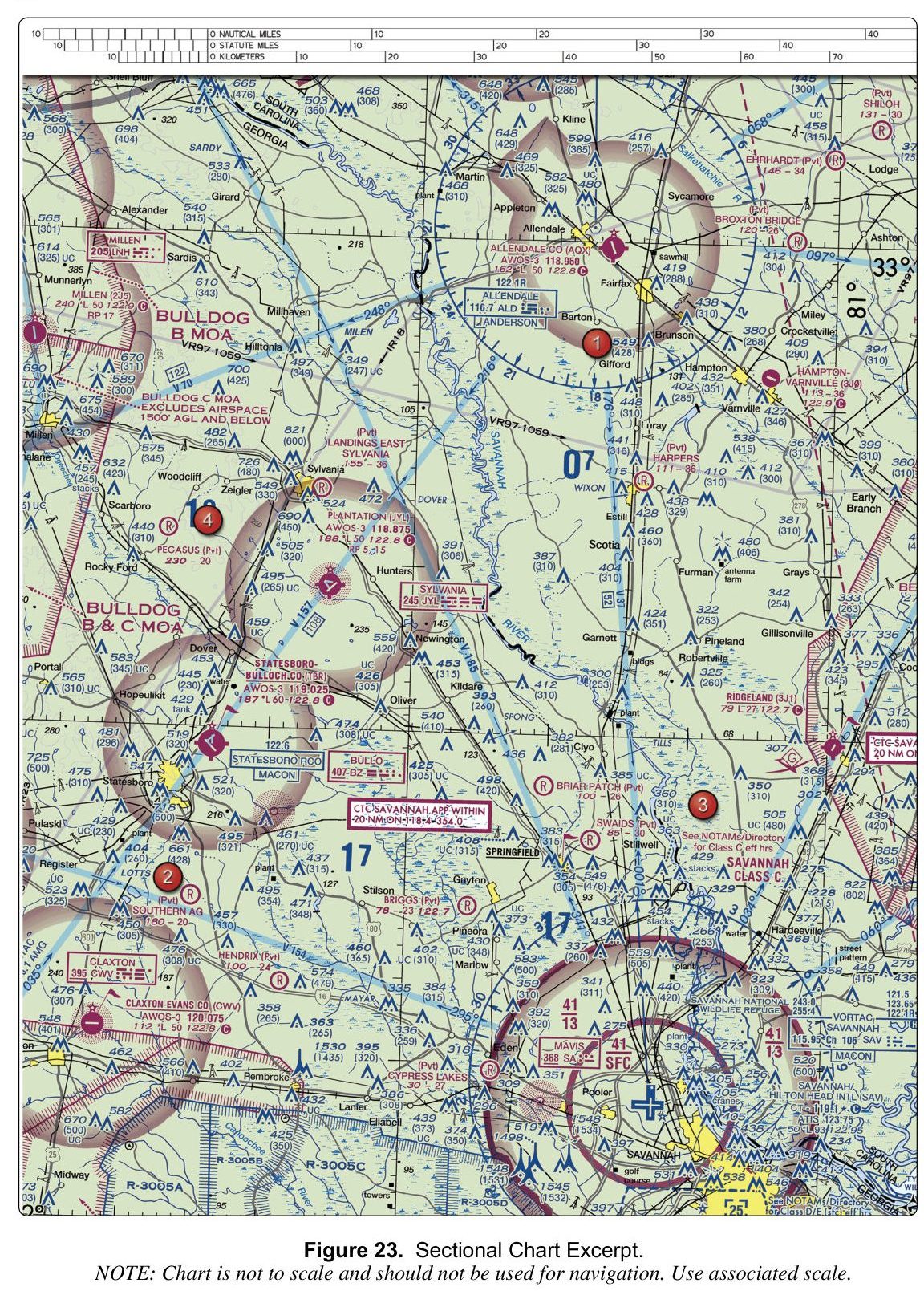
38. (Refer to FAA-CT-8080-2H, Figure 23.) The note printed on the chart for BULLDOG C MOA states that the MOA:
Figure 23 — Sectional chartOpen reference image
From the FAA testing supplement (FAA-CT-8080-2H). Tap the image to open it full size.
Why: On Figure 23, the special-use airspace labeled BULLDOG C MOA carries a printed note that reads 'EXCLUDES AIRSPACE 1500' AGL AND BELOW.' The unit is explicitly AGL, not MSL, so the option stating 1500' MSL is a misread of the unit. The value 1300' does not appear in the note; it may be confused with the 41/13 ceiling-over-floor figure printed on the Savannah Class C airspace nearby.
39. A remote pilot wants an early look at the weather for a flight planned for tomorrow afternoon. Which type of FAA Flight Service briefing is most appropriate?
Why: An Outlook Briefing is intended for early planning when the proposed departure is six or more hours away. Because forecasts can change significantly before departure, the pilot should get updated weather closer to the flight, usually as a Standard Briefing. An Abbreviated Briefing is mainly used to update a previous briefing or obtain specific items.
40. Before a routine night flight under Part 107, which requirement must the remote pilot in command meet?
Why: Under 14 CFR 107.29(a)(1), the remote pilot in command must have completed an initial knowledge test or training, as applicable, under 107.65 after April 6, 2021, and must remain current. For a new applicant who does not hold a Part 61 pilot certificate, that means the initial knowledge test, not a training course. The aircraft must also have anti-collision lighting visible for at least 3 statute miles with a flash rate sufficient to avoid a collision, which may be dimmed for safety but not extinguished. Night operations do not automatically require a visual observer, and since the 2021 rule change they no longer need a waiver when these requirements are met. Other operating and airspace requirements still apply.
41. Which statement best describes the IMSAFE checklist in the context of Part 107 operations?
Why: IMSAFE is a guidance tool, not a regulation. It is a personal checklist a pilot uses before flight to evaluate whether any of those six factors might interfere with safe operation. It is not filed with the FAA and is not a training module. The underlying regulatory requirement is that no person may act as remote PIC, person manipulating the controls, visual observer, or direct participant when they know or have reason to know of a physical or mental condition that would interfere with safe operation, but IMSAFE itself is the practical method for making that self-assessment.
42. A remote pilot discovers that the planned flight area for a commercial aerial-mapping job is inside a prohibited area shown on the sectional chart. Which statement about operating there under Part 107 is correct?
Why: Under 14 CFR 107.45, no person may operate a small unmanned aircraft in a prohibited or restricted area without permission from the using or controlling agency, as appropriate; for a prohibited area, that is the using agency. A Part 107 certificate of waiver does not substitute for this permission, because 107.45 is not among the regulations listed as waivable in 107.205. Prohibited areas exist for national-security or national-welfare reasons and normally have a continuous time of designation, so they should not be treated like joint-use restricted areas, which may be released to ATC when not in use.
43. A remote pilot plans to hover a Category 2 drone above the audience at an outdoor concert to film it. What must be true for this operation?
Why: Hovering above a crowd is sustained flight over an open-air assembly. In Categories 1, 2 and 4 that is allowed only if the operation complies with Remote ID. Category 2 eligibility alone is not enough, and no waiver is needed when the Category 2 and Remote ID requirements are met.
44. A METAR reports: FEW020 SCT035 BKN050. What is the reported ceiling?
Why: For aviation purposes, the ceiling is the height of the lowest cloud layer reported as broken (BKN) or overcast (OVC), or the vertical visibility into an obscuration. BKN050 therefore establishes a ceiling of 5,000 feet AGL. FEW020 and SCT035 do not constitute ceilings.
45. A runway is designated as runway 18. What is the approximate magnetic heading of that runway?
Why: Runway numbers are derived by taking the magnetic heading of the runway, rounding it to the nearest 10 degrees, and dividing by 10. A runway numbered 18 therefore has a magnetic heading of approximately 180 degrees. The 90-degree option would correspond to runway 09, and the 270-degree option would correspond to runway 27. Neither matches the designation 18.
46. Which of the following accurately identifies actions Part 107 requires before a flight?
Why: Under 14 CFR 107.15, the remote pilot in command must check the small UAS before each flight to determine that it is in a condition for safe operation. Under 107.49 they must also assess the operating environment (local weather, airspace and flight restrictions, people and property on the surface, and other ground hazards); brief directly participating persons; ensure all control links work properly; ensure enough available power for the intended operational time; ensure any attached or carried object is secure and does not affect flight characteristics or controllability; and, when applicable, confirm the aircraft meets the requirements for its category of operation over people. Part 107 has no routine requirement for a certificated mechanic to inspect the drone.
47. Which of the following airspace classes does NOT require an ATC airspace authorization for a remote pilot to operate a small unmanned aircraft?
Why: Prior ATC authorization is required in Class B, C and D airspace and within the lateral boundaries of the Class E surface area designated for an airport. Class G is uncontrolled and does not itself trigger this airspace-authorization requirement; other flight restrictions still apply. Not every surface-level Class E extension is an airport-designated surface area.
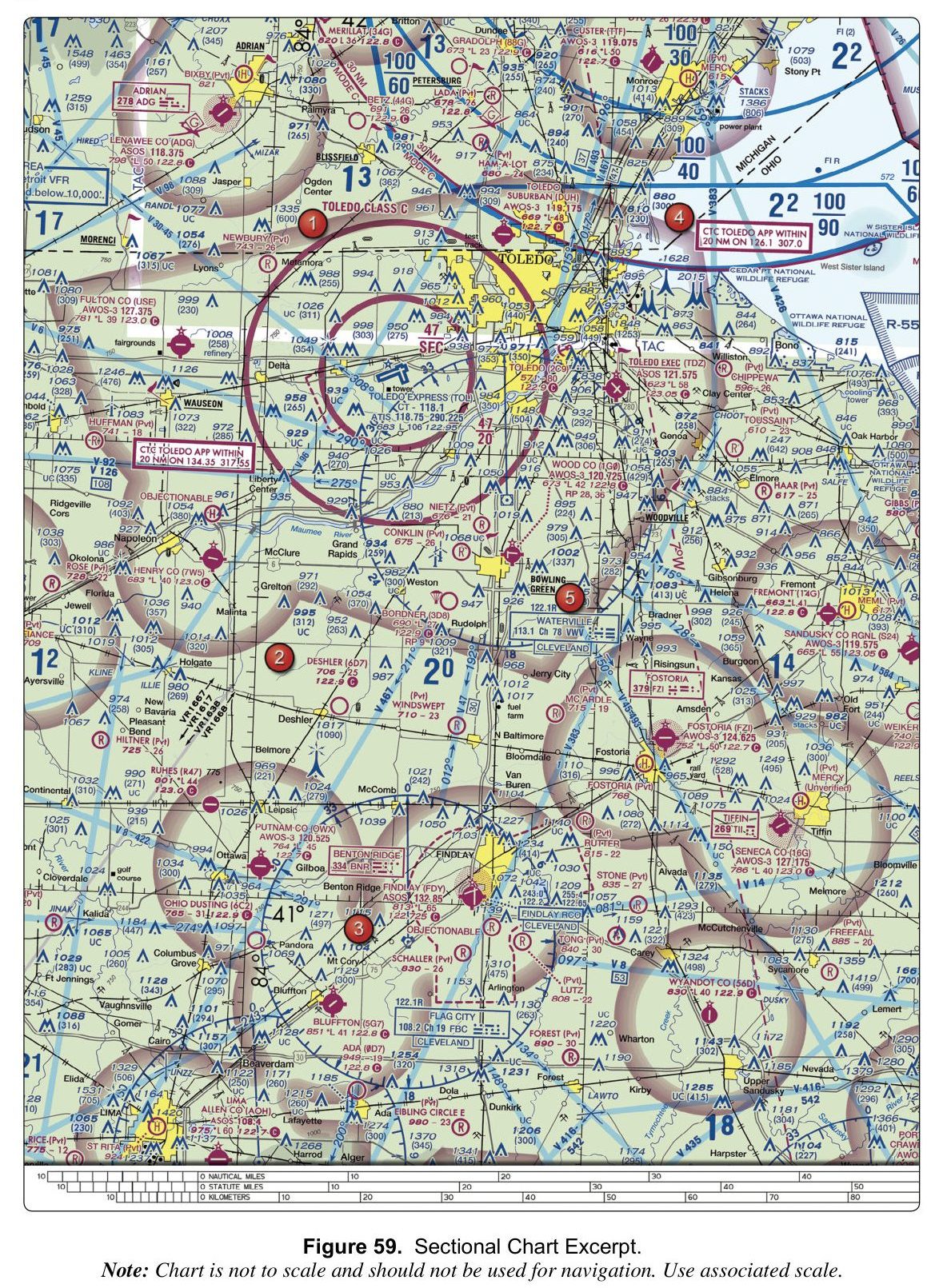
48. (Refer to FAA-CT-8080-2H, Figure 59.) What is the tower frequency for Toledo Express Airport (TOL)?
Figure 59 — Sectional chartOpen reference image
From the FAA testing supplement (FAA-CT-8080-2H). Tap the image to open it full size.
Why: In the Toledo Express (TOL) data block, 'CT - 118.1' is the control tower frequency. 118.75 is the ATIS frequency printed after it, and 118.375 is the ASOS frequency at Lenawee Co (ADG), a different airport on the chart.
49. A remote pilot in command experiences a battery failure that will cause the drone to crash within 30 seconds. The pilot deviates from the visual line of sight rule to maneuver the aircraft toward a safe landing area. Which statement is correct?
Why: In an in-flight emergency requiring immediate action, the remote pilot in command may deviate from any rule of Part 107 to the extent necessary to meet that emergency (14 CFR 107.21(a)), including visual line of sight, and no waiver is needed beforehand. The authority is not limited to particular rules such as altitude or speed. A waiver is a separate authorization for planned operations. If the FAA asks, the pilot must send a written report of the deviation (107.21(b)).
50. A remote pilot's drone strikes a parked vehicle during a commercial aerial photography operation. The vehicle owner estimates the repair cost at $480. Which statement about the reporting requirement is correct?
Why: A remote pilot in command must report to the FAA within 10 calendar days any operation involving serious injury, loss of consciousness, or damage to property other than the drone, unless the repair cost does not exceed $500 (or the property is worth $500 or less if destroyed) (14 CFR 107.9). A $480 repair is below the threshold, so no report is required. Contact alone does not trigger a report, and there is no $100 threshold.
51. (Refer to FAA-CT-8080-2H, Figure 59.) What is the common traffic advisory frequency (CTAF) for Lenawee County Airport (ADG)?
Figure 59 — Sectional chartOpen reference image
From the FAA testing supplement (FAA-CT-8080-2H). Tap the image to open it full size.
Why: On the chart, the airport symbol for Lenawee County (ADG) has the frequency 122.8 printed beside it as its CTAF. The value 122.9 is the CTAF for several nearby airports including Gradolph (88G), Bordner (3D8), Deshler (6D7), and Wyandot County (56D), and 123.0 is the CTAF for Fulton County (USE) and Ruhes (R47).
52. A manned aircraft reports "left downwind, runway 27" on the CTAF. In which general direction is the aircraft flying?
Why: The downwind leg is flown parallel to the landing runway in the direction opposite landing. Runway 27 has a landing direction of about 270° magnetic, so an aircraft on downwind for runway 27 is flying about 090° magnetic. "Left" identifies which side of the runway the pattern is on; it does not change the fact that the aircraft is travelling roughly opposite the landing direction.
53. A recreational flyer owns a 0.4 lb (approximately 180 g) drone and flies it exclusively for recreation. The drone has not been registered with the FAA. Which statement about Remote ID requirements is correct?
Why: The Remote ID operating rules apply to persons operating unmanned aircraft that are registered or required to be registered (14 CFR 89.101(a)). A drone under 250 g (0.55 lb) flown exclusively for recreation does not have to be registered, so if it has not been registered it is outside the Remote ID rule. If the owner registers it voluntarily, or flies it under Part 107 (where every drone must be registered), Remote ID applies. Being in U.S. airspace does not by itself trigger Remote ID, and the rule has no airport-distance condition.
54. An airport data block on a sectional chart shows *L. What does this indicate about airport lighting?
Why: On a sectional chart, L indicates lighting is in operation from sunset to sunrise. An asterisk before the L (*L) means lighting limitations exist, and the pilot should consult the Chart Supplement for the specific limitation. The symbol does not identify the lighting as high-intensity, and it does not mean there is no lighting.
55. (Refer to FAA-CT-8080-2H, Figure 23.) The obstacle just east of area 1, near Gifford, has a height of:
Figure 23 — Sectional chartOpen reference image
From the FAA testing supplement (FAA-CT-8080-2H). Tap the image to open it full size.
Why: Next to area 1, beside Gifford, the obstacle is labelled 549 with (428) beneath it. The bold number is the height of the top above mean sea level; the number in parentheses is its height above ground level. So it is 549 feet MSL, or 428 feet above the ground.
56. A UAS Facility Map shows a value of 350 feet AGL for a particular grid. What does that value indicate?
Why: UAS Facility Maps show altitudes that the FAA has determined can generally be authorized without additional safety analysis or facility coordination. The value does not itself permit flight in controlled airspace; the pilot must still obtain an airspace authorization, at any altitude. For Part 107 operations, a pilot may also submit a LAANC Further Coordination request to fly above the displayed altitude, up to 400 feet AGL, subject to FAA review. So 350 feet is neither a no-authorization altitude nor the highest altitude that can ever be approved.
57. A small unmanned aircraft registration issued through FAA DroneZone under Part 48 is normally valid for:
Why: Registration under Part 48 is valid for 3 years unless it ends earlier under the applicable rules. Renew it before expiration to keep operating an aircraft that requires registration. This question concerns Part 48 registration through DroneZone, not the separate Part 47 aircraft-registration system.
58. A recreational flyer previously registered a drone and answered 'No' to the Remote ID question during that registration. The flyer now wants to add Remote ID compliance for that same drone. What must the flyer do?
Why: The FAA's instructions for recreational flyers state that if you previously listed a drone and answered 'No' to the Remote ID question, you will now create a new listing for that same drone. This is different from the Part 107 workflow, where the pilot edits the existing registration to change the Remote ID selection to 'Yes.' The 'edit the existing registration' option describes the Part 107 process, not the recreational process. The 'cancel and re-register' option is unnecessary because the FAA specifically directs recreational flyers to create a new listing rather than canceling and starting over.
59. What is the difference in the location information broadcast by a Standard Remote ID drone versus a drone equipped with a Remote ID broadcast module?
Why: A Standard Remote ID drone is produced with built-in broadcast capabilities that provide identification and location information about the drone and the control station. A Remote ID broadcast module, by contrast, broadcasts identification and location information about the drone and its take-off location. This distinction matters operationally: the control station location is more dynamic (it updates as the pilot moves), while the take-off location is a fixed point established at the start of the flight.
60. When a visual observer is used during a Part 107 operation, which of the following is required?
Why: When a visual observer is used, the remote pilot, whoever is flying the aircraft and the observer must maintain effective communication at all times. Effective is the test: radios are fine, and so is speaking, as long as it works throughout the flight. The observer needs no certificate, and Part 107 sets no distance limit between observer and pilot, though the observer must be able to see the aircraft.
61. A U.S. military TAF contains: PROB40 2622/2702 3SM -TSRA BKN010CB. What does the group indicate?
Why: PROB40 indicates a 40-percent probability category for the listed forecast conditions during the specified period. The group 2622/2702 means from 2200 UTC on the 26th until 0200 UTC on the 27th. The probability applies only to that stated time window, not to the entire TAF. 3SM -TSRA BKN010CB indicates 3 statute miles visibility, light thunderstorm rain, and a broken cumulonimbus layer at 1,000 feet AGL. Important U.S. note: civilian National Weather Service TAFs do not use PROB40; NWS TAFs use PROB30 as their probability group. PROB40 may appear in U.S. military and international TAFs.
62. A remote pilot plans to operate a small unmanned aircraft at a distance where neither the remote pilot nor any visual observer can maintain continuous visual contact with the aircraft. What is required before conducting this operation?
Why: Keeping the aircraft within visual line of sight is one of the rules the FAA will waive, so an operation where neither the remote pilot nor a visual observer can see the aircraft needs a Part 107 waiver before it is flown. Remote ID is a separate requirement: broadcasting identification tells others who is flying, it does not relieve anyone of the duty to see the aircraft. LAANC gives airspace authorization to fly in controlled airspace near an airport, which is a different permission and says nothing about flying beyond visual line of sight.
63. A remote pilot plans to fly a 0.4 lb drone for a commercial aerial mapping job under Part 107. Must the drone be registered with the FAA?
Why: Every drone flown under Part 107 must be registered, whatever it weighs, so a 0.4 lb drone used for a paid mapping job needs registration. The 0.55 lb exemption applies only to drones flown purely for recreation, so applying it to a commercial flight is wrong. It is also wrong to say registration applies only to recreational flyers: that inverts the rule.
64. A remote pilot plans to operate a small unmanned aircraft within the lateral boundaries of the Class B airspace core area at a large airport, where the airspace extends from the surface. What must the remote pilot obtain before the flight?
Why: Class B airspace, including its core area that extends from the surface, is controlled airspace. Part 107 requires prior ATC authorization before operating within Class B airspace, typically obtained through LAANC or the FAA's drone zone system. The "waiver" option is incorrect because a waiver is not needed for a standard controlled airspace operation; the pilot simply needs the standard airspace authorization. The "no additional authorization" option is wrong because Class B is controlled airspace and the standard Part 107 operating limits alone do not permit entry without prior authorization.
65. Before flight, what does Part 107 require the remote pilot in command to do about weather?
Why: Part 107 makes the preflight assessment the remote pilot's own duty: before flight they must assess the operating environment, and that assessment must include local weather conditions, local airspace and flight restrictions, the location of people and property, and other ground hazards. A Flight Service briefing is good practice but no particular source is required, and Part 107 sets no ceiling minimum: its weather limits are 3 statute miles of visibility and 500 feet below and 2,000 feet horizontally from clouds.
66. What is the maximum groundspeed permitted for a small unmanned aircraft under standard Part 107 rules?
Why: Section 107.51(a) limits the groundspeed of a small unmanned aircraft to 87 knots (100 miles per hour). The limit is groundspeed, so a tailwind counts toward it. It can be waived; the other figures are not Part 107 limits.
67. A remote pilot is conducting a night operation. The anti-collision light is causing glare that makes it difficult to see the aircraft. What does the rule allow the pilot to do?
Why: The remote pilot may reduce the intensity of the anti-collision lighting when, because of operating conditions, that is in the interest of safety, which includes glare that makes the aircraft hard to see. The rule does not allow the lighting to be extinguished, even for a while, and position lights alone do not meet the anti-collision requirement: lighting visible for at least 3 statute miles with a flash rate sufficient to avoid a collision.
68. On a US sectional chart, how is Class D airspace depicted?
Why: Class D airspace is depicted with a dashed blue line on US sectional charts. The solid blue line option is wrong because that is the depiction for Class B airspace. The dashed magenta line option is wrong because that is the depiction for Class E airspace extending to the surface. Distinguishing these line styles and colors is essential for identifying which airspace class surrounds a given airport and what authorization or operating rules apply.
69. Class B airspace around a large airport typically extends from the surface up to what altitude?
Why: Class B airspace typically tops out around 10,000 feet MSL, but the real figure is printed on the sectional chart for each airport and varies. 2,500 feet above the airport is the usual top of Class D, and 12,500 feet is not a standard airspace boundary. For a drone flight, read the chart rather than relying on a typical value.
70. A remote pilot is conducting a search-and-rescue operation and needs to deliver a supply package to a stranded person on a remote trail. The pilot releases the package from the drone in flight. Which statement about the regulatory requirement is correct?
Why: No person may allow an object to be dropped from a small unmanned aircraft in a manner that creates an undue hazard to persons or property (14 CFR 107.23(b)). That is a conditional rule, not a blanket ban, so a drop made without creating an undue hazard is allowed without a waiver. (Carrying property for compensation is a separate question with its own limits.)
71. The Maximum Elevation Figure in a quadrangle on a sectional chart shows a large "3" followed by a smaller "5." What altitude does this represent?
Why: Maximum Elevation Figures (MEFs) are expressed in thousands and hundreds of feet MSL, so a large 3 followed by a smaller 5 represents 3,500 feet MSL. An MEF is a conservative maximum elevation for the quadrangle based on terrain and vertical obstacles: the FAA applies source-data error allowances and rounds up to the next 100 feet, so it is not simply the exact elevation of the single highest object.
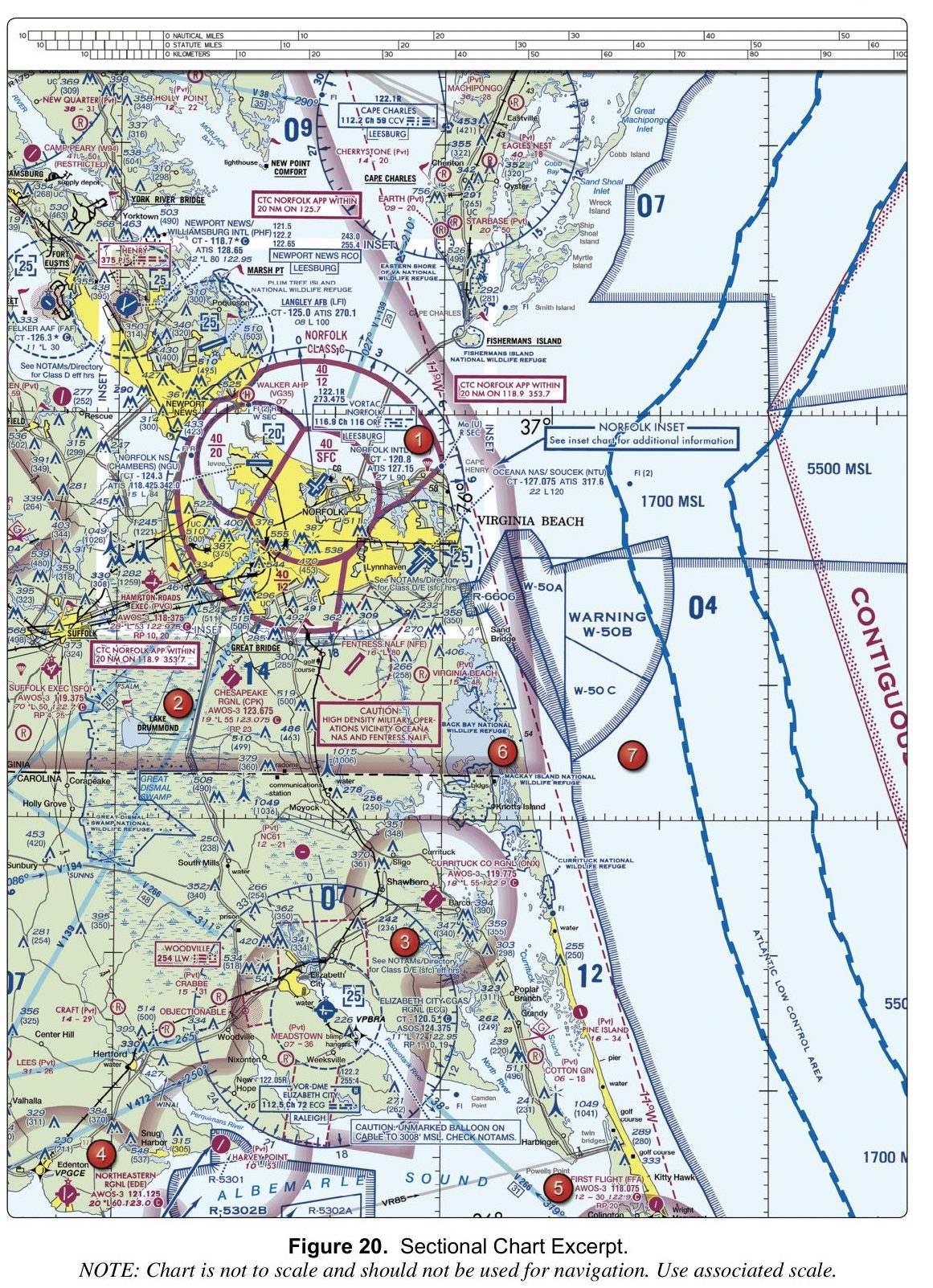
72. (Refer to FAA-CT-8080-2H, Figure 20.) What is the tower frequency for Newport News/Williamsburg International (PHF)?
Figure 20 — Sectional chartOpen reference image
From the FAA testing supplement (FAA-CT-8080-2H). Tap the image to open it full size.
Why: In the airport data block for Newport News/Williamsburg Intl (PHF), 'CT - 118.7' is the control tower frequency. 128.65 is the ATIS frequency printed on the line below it, and 118.425 is the ATIS frequency for Norfolk NS (Chambers), a different airport on the chart.
73. The IMSAFE mnemonic used by remote pilots to evaluate personal fitness for flight stands for:
Why: The IMSAFE checklist covers Illness, Medication, Stress, Alcohol, Fatigue, and Emotion (some FAA publications also include Eating). The 'sleep' option is wrong because IMSAFE addresses fatigue as a broad condition, not specifically sleep deprivation as a separate item. The 'injuries' option is wrong because the mnemonic uses 'Illness,' which encompasses both acute and chronic health conditions but is the specific word in the acronym.
74. During operations under a Part 107 certificate of waiver, where must a copy of the waiver be kept?
Why: Operations under a waiver must meet the waiver's conditions, and its standard provisions require a copy of the certificate of waiver to be available to the remote pilot in command at the control station during covered operations. Nothing is filed with the FSDO before each flight, and the waiver is not displayed on the aircraft. Always follow the specific document requirements in your own waiver.
75. A remote pilot reviews: KJFK 251755Z 36012KT 10SM FEW250 18/09 A2992. What does 251755Z indicate?
Why: The METAR observation-time group uses the format DDHHMMZ: DD is the day of the month, HH the hour, MM the minute, and Z means UTC (Zulu time). Therefore, 251755Z means the 25th day of the month at 17:55 UTC. It is not local time, and a METAR has no validity period: it reports conditions at the time of observation.
76. A remote pilot in command deviated from Part 107 operating rules to address an in-flight emergency. What is the pilot's obligation regarding reporting the deviation?
Why: Under 14 CFR 107.21(b), a remote PIC who deviates from a rule to meet an in-flight emergency must, upon request of the Administrator, send a written report of that deviation. The report must be in writing; the rule does not say how the request is made. A report is owed if the FAA asks, so the 'no reporting of any kind' option is wrong, and the 10-calendar-day deadline belongs to the accident-reporting rule (107.9: serious injury, loss of consciousness, or property damage over $500), not to emergency deviations.
77. A remote pilot is planning a flight 12 nautical miles from a severe thunderstorm. Which hazard could still affect the small UA at that distance?
Why: The visible cloud is only part of a thunderstorm's hazardous environment. Severe turbulence can extend well outside a severe thunderstorm, and gust fronts or other outflow winds can travel well ahead of the precipitation and visible cloud boundary. A small UA only 12 nautical miles from a severe thunderstorm may therefore encounter major wind shifts, turbulence, or strong outflow despite being outside the visible cloud. FAA guidance calls for substantial separation from severe or intense thunderstorms rather than treating the cloud edge as the hazard boundary.
78. An organization responding to a natural disaster needs to operate a drone under Part 107 in a manner that deviates from a standard rule. Which statement about the waiver process in this context is correct?
Why: The FAA provides for expedited approvals for first responders and other organizations responding to natural disasters or other emergency situations, meaning the standard processing timeline can be shortened. The FAA handles these requests through its Special Governmental Interest (SGI) process. However, a waiver is still required; there is no automatic exemption from Part 107 rules for emergency operations. Waiting the full standard processing time ignores the expedited pathway, and claiming automatic exemption from all rules is incorrect because authorization remains necessary.
79. Under standard Part 107 rules, a remote pilot plans to fly at 600 feet AGL over flat terrain and more than 400 feet horizontally from any structure. What is required?
Why: The normal maximum is 400 feet AGL. Within a 400-foot radius of a structure, the aircraft may fly up to 400 feet above that structure’s immediate uppermost limit. This flight is more than 400 feet horizontally from any structure, so that exception does not apply; the planned operation requires an FAA-approved waiver of the altitude limit. Part 107 has no special pilot-certificate endorsement for high-altitude flights.
80. A remote pilot slept four hours last night and has a head cold. Applying the IMSAFE checklist, what is the best decision?
Why: IMSAFE covers Illness, Medication, Stress, Alcohol, Fatigue and Emotion. A cold and a short night hit two items. Section 107.17 also prohibits acting as remote PIC, visual observer or person manipulating the controls when you know or have reason to know of a physical or mental condition that would interfere with safe operation.
81. A TAF contains: TEMPO 1418/1422 6SM -RA BKN015. What does this group indicate?
Why: TEMPO identifies temporary fluctuations in forecast conditions. The time group 1418/1422 means from 1800 UTC to 2200 UTC on the 14th. The temporary conditions are generally expected to last less than one hour at a time and, in total, occur during less than half of the stated period. -RA means light rain, and BKN015 represents a broken layer, and therefore a ceiling, at 1,500 feet AGL. A gradual change is represented by BECMG where that format is used, while a new prevailing condition beginning at a specified time is normally represented by an FM group.
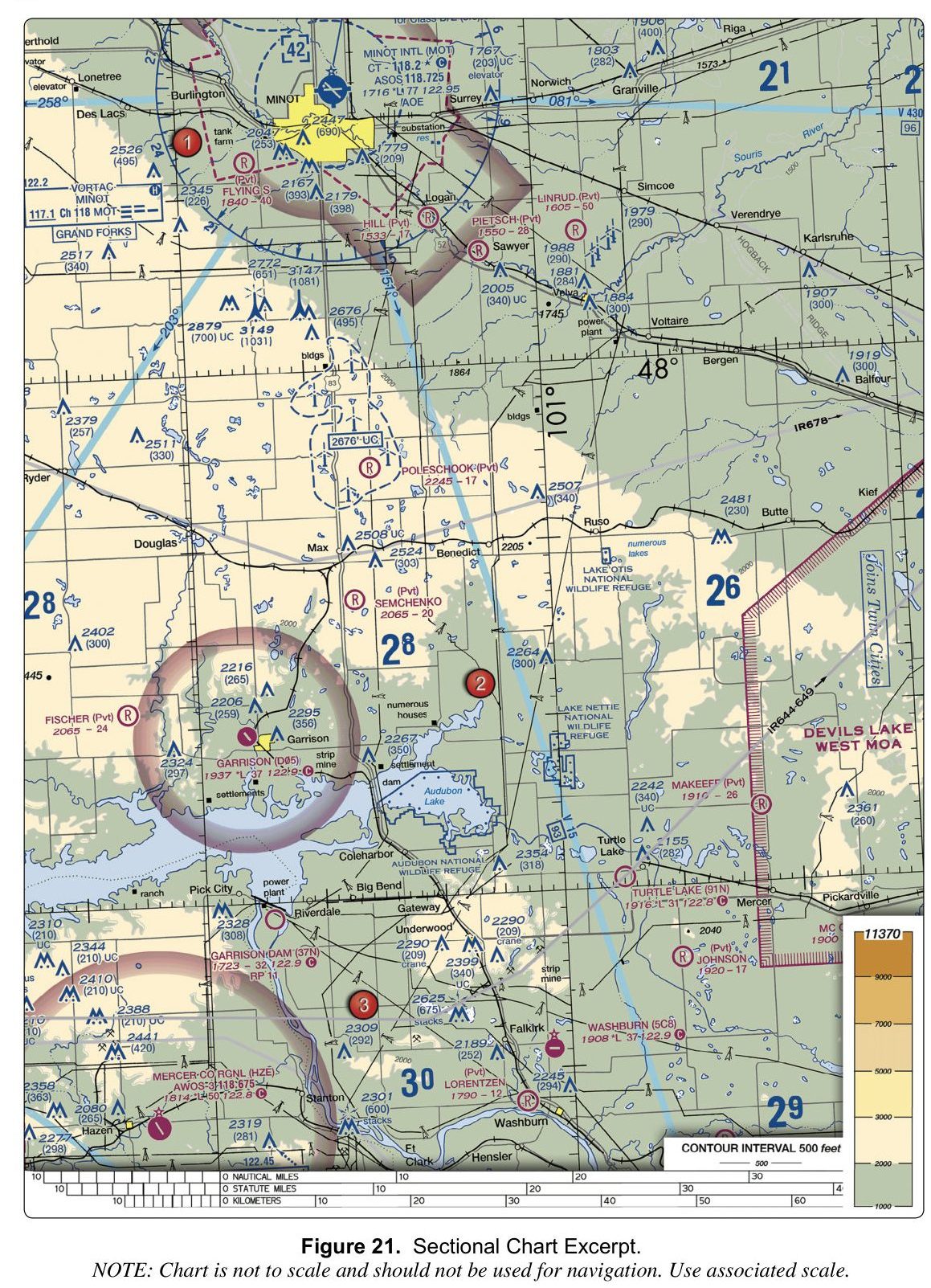
82. (Refer to FAA-CT-8080-2H, Figure 21.) What is the CTAF for Minot Intl (MOT)?
Figure 21 — Sectional chartOpen reference image
From the FAA testing supplement (FAA-CT-8080-2H). Tap the image to open it full size.
Why: In the Minot Intl (MOT) data block, 'CT - 118.2' is the control tower frequency. The star means the tower operates part-time, and the C in a circle after it means 118.2 is also the CTAF when the tower is closed. 118.725 is the ASOS weather frequency on the next line. 122.9 is the CTAF at other airports on the chart, such as Garrison Dam and Washburn.
83. A remote PIC has completed every manufacturer-recommended maintenance and inspection procedure, and all pass. During a final visual check, the PIC notices a hairline crack in the airframe near a motor mount. The manufacturer's manual does not list this specific inspection point. What must the PIC do?
Why: Under 14 CFR 107.15(a), no person may operate a civil small UAS unless it is in a condition for safe operation, and before each flight the remote PIC must check it and determine that it meets that standard. Completing the manufacturer's checklist does not override a defect found during the inspection. A crack near a motor mount could affect structural integrity, so it must be evaluated or corrected before the aircraft is operated; the checklist is a tool for determining safe condition, not permission to ignore a defect observed independently. Flying slower does not make an unsafe aircraft safe.
84. A client asks a remote pilot to carry a container of hazardous material with a small UAS. Under Part 107, which statement is correct?
Why: Section 107.36 prohibits a small unmanned aircraft from carrying hazardous material. It is not on the list of waivable rules in section 107.205, so an ordinary Part 107 waiver cannot authorize it; relief would require an exemption under 14 CFR part 11. Packaging the material to DOT standards does not change the prohibition.
85. A remote pilot is conducting an operation that requires a visual observer to help maintain visual line of sight. Mid-operation, the visual observer's communication device fails and they can no longer maintain effective communication with the remote pilot. What must the remote pilot do?
Why: Part 107 requires the remote PIC to ensure effective communication with any visual observer at all times during the operation. If that communication is lost, the remote PIC can no longer rely on that visual observer to help maintain visual line of sight, and the operation must be suspended until communication is restored or the need for that visual observer is eliminated. The 'present at the start' option is wrong because the requirement is continuous, not a one-time condition satisfied at the beginning. The 'onboard cameras' option is wrong because visual line of sight is defined by unaided human vision from the control station or a visual observer, not by the aircraft's own sensors.
86. Which airspace class generally extends from 18,000 feet MSL up to and including flight level 600 over the contiguous United States?
Why: This is the general vertical range of Class A airspace. Class B has individually defined boundaries around busy airports. Class E includes several different types of controlled airspace, including airspace above flight level 600. This airspace-classification question does not authorize a Part 107 drone flight at these altitudes.
87. What is the typical vertical extent of Class C airspace?
Why: Class C airspace normally extends from the surface to 4,000 feet above the airport elevation, charted in MSL. The 2,500-foot figure belongs to Class D, the airspace around smaller airports with an operating control tower. Surface to 10,000 feet MSL is the typical shape of Class B, around the busiest airports. Each Class C area's actual dimensions are shown on the sectional chart.
88. What is a temperature inversion in the atmosphere?
Why: A temperature inversion is defined as a layer where temperature increases with altitude, which is the opposite of the normal lapse rate. The option describing a decrease with altitude is simply the normal atmospheric lapse rate, not an inversion. The option describing a constant temperature describes an isothermal layer, which is a different phenomenon and not an inversion.
89. A METAR includes the wind group 32015G22KT. What does it report?
Why: In a METAR the first three digits are the direction the wind is blowing from, in degrees true; the next two are the sustained speed in knots; G introduces the gust speed. 32015G22KT is from 320 degrees true at 15 knots, gusting 22 knots.
90. A remote pilot plans to use a visual observer during a Part 107 operation and will follow all visual observer requirements. Is a waiver required for this?
Why: A visual observer is a permitted crew role, not a deviation from the rules. The visual-line-of-sight rule says the required ability to see the aircraft may be exercised either by the remote pilot in command together with the person manipulating the controls, or by a visual observer. The crew must keep effective communication at all times, the remote PIC must make sure the observer can see the aircraft as the rule requires, and the crew must coordinate their scan of the airspace. A waiver is needed only to deviate from those visual-observer requirements, which is why the FAA lists that deviation as a waivable situation.
91. A remote pilot holds a Part 107 waiver for operations beyond visual line of sight. The pilot now wants to also operate from a moving land vehicle during the same project. Which statement is correct?
Why: A certificate of waiver authorizes deviation only from the Part 107 rules listed on it, for the operation it describes (14 CFR 107.200, 107.205). A waiver can cover more than one rule when the applicant requests them, so the pilot needs FAA approval that covers the moving-vehicle rule (107.25), either as a new waiver or an amendment to the existing one, showing how that operation will be conducted safely. Even with that waiver, the FAA will not authorize carrying another person's property for compensation or hire. The automatic-inclusion option is wrong because a waiver does not extend to rules it does not list, and the overall-competence option is wrong because the FAA evaluates each deviation on its own safety case.
92. A remote pilot intends to operate a small UAS within Class D airspace. What must the remote pilot do before beginning the operation?
Why: Class D is controlled airspace, and Part 107 requires ATC authorization before you fly there. Drone pilots get it through LAANC, which gives near-real-time approval at participating airports, or by applying through FAA DroneZone; you do not call the tower to get it. A flight plan is not part of the process, and a waiver is not needed because authorization, not a waiver, is what airspace access requires.
93. A remote pilot's Category 3 drone has a category label that has become faded and partially illegible after prolonged sun exposure. What must the remote pilot do before conducting operations over human beings?
Why: If a Category 2 or Category 3 label is damaged, destroyed or missing, the remote pilot in command must relabel the aircraft in English, so that the label is legible, prominent and will remain on the aircraft for the duration of the operation, before flying over human beings. The label must correctly identify the category the aircraft is eligible for. There is no report to file with the FAA for a worn label, and removing it does not help: without a legible label the aircraft is not eligible for the operation, whether or not anyone inspects it.
94. A remote pilot takes a new over-the-counter medication for the first time on the morning of a planned flight and notices no immediate side effects. According to FAA fitness-to-fly guidance, what is the best action?
Why: Under 14 CFR 107.17, a person may not act as remote pilot in command, manipulate the controls, serve as a visual observer, or directly participate in the operation if they know or have reason to know of a physical or mental condition that would interfere with safe operation. FAA guidance on over-the-counter medications adds a specific precaution: after the first dose of a new medication, wait at least 48 hours and confirm that no side effects occur before flight duties. Feeling fine shortly after the first dose does not show the medication will not affect you, and the 8-hour rule applies to alcohol, not medication.
95. A remote pilot reads: KJFK 251755Z 36012KT 10SM FEW250 18/09 A2982. What does A2982 indicate?
Why: In a U.S. METAR, an altimeter group beginning with A gives the altimeter setting in hundredths of an inch of mercury. A2982 therefore means 29.82 inHg. An international report may use a Q group for pressure expressed in hectopascals, such as Q1013.
96. A pilot is landing on runway 32. What is the reciprocal runway designation for the opposite end of the same physical runway?
Why: Opposite ends of the same runway are reciprocals of each other, and their designations differ by exactly 18 (representing 180 degrees). Subtracting 18 from 32 gives 14, so the opposite end is runway 14. The 08 option would require a difference of 24, and the 20 option would require a difference of 12; neither represents a true reciprocal pair.
97. During a Part 107 operation, a local police officer asks the remote pilot in command for their credentials. What must the remote pilot do?
Why: Under 14 CFR 107.7, a remote pilot exercising certificate privileges must have the remote pilot certificate and required identification in their physical possession and readily accessible, and must present them on request to the FAA Administrator, an authorized NTSB representative, any Federal, State, or local law enforcement officer, or an authorized TSA representative. A local police officer is therefore authorized to request both.
98. Which surface conditions are most favorable for development of a ground, or radiation, temperature inversion?
Why: A radiation inversion commonly forms at night when the earth's surface loses heat by terrestrial radiation and cools the air in contact with it. Clear skies make that radiational cooling efficient, and with little or no wind the cooled air near the ground is not mixed with the warmer air above, leaving a layer in which temperature increases with height. Cloud cover reduces nighttime radiational cooling, and stronger winds mix the lower atmosphere and inhibit a strong surface inversion.
99. A Category 3 drone is used to inspect a construction site with restricted access. Under which condition may it fly over the workers on the site?
Why: Category 3 flight over people is allowed within or over a closed- or restricted-access site when everyone on the site is on notice that a drone may fly over them, subject to the other Category 3 requirements, including no flight over open-air assemblies. The alternative rule limits sustained flight over people to those directly participating in the drone operation or people beneath a covered structure or inside a stationary vehicle that provides reasonable protection from a falling drone. Hard hats and a low altitude do not substitute for these conditions.
100. A small UAS accident results in serious injury to a person. Within what time must the remote pilot in command report it to the FAA?
Why: Section 107.9 requires the remote pilot in command to report to the FAA, within 10 calendar days, any operation that results in serious injury to a person, any loss of consciousness, or damage to property other than the small unmanned aircraft unless the cost of repair or the fair market value of the property is $500 or less. 30 days and 24 hours are not the Part 107 deadline.
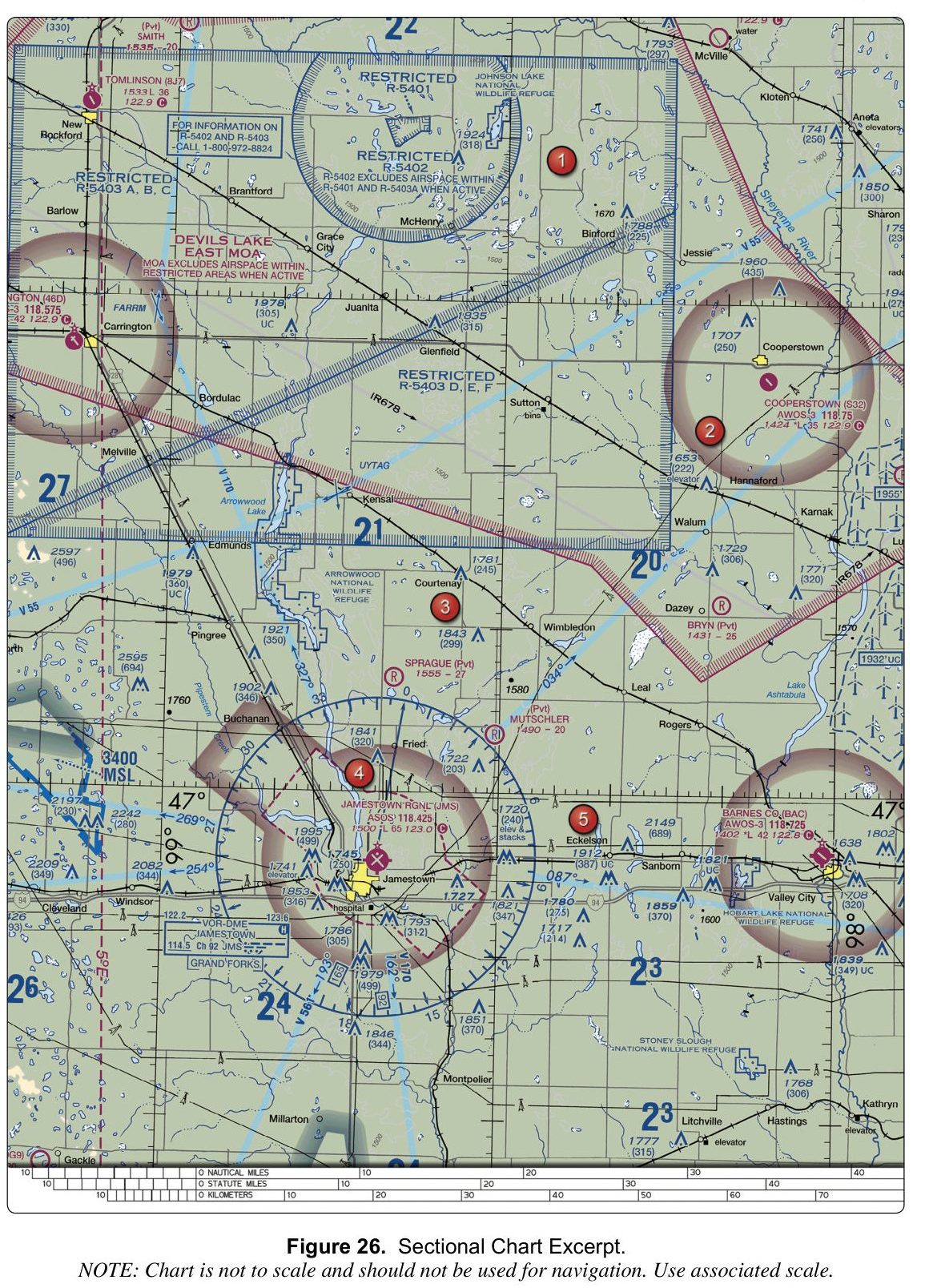
101. (Refer to FAA-CT-8080-2H, Figure 26.) What is the Common Traffic Advisory Frequency (CTAF) listed for Tomlinson (8J7)?
Figure 26 — Sectional chartOpen reference image
From the FAA testing supplement (FAA-CT-8080-2H). Tap the image to open it full size.
Why: On the chart, the Tomlinson (8J7) airport entry shows the CTAF listed as 122.9. The value 118.425 is the ASOS frequency for Jamestown RGNL (JMS), and 118.725 is the AWOS-3 frequency for Barnes Co. (BAC). These are weather-broadcast frequencies, not CTAF values, and belong to different airports.
102. A recreational flyer has two drones of the same make and model and one Remote ID broadcast module. The flyer wants to attach the module to either drone as needed for different flights. Under the registration rules, what must be true for this arrangement to be compliant?
Why: FAA registration guidance lets a recreational flyer move one broadcast module between drones in their inventory, provided the module's serial number is listed for each drone it will be used with. The regulation allows more than one module serial number on a registration and bars listing one module on more than one Certificate of Aircraft Registration at the same time (14 CFR 48.110(a)(7)); a recreational flyer's inventory is a single certificate. Nothing requires a dedicated module for each drone, and a Letter of Authorization is for operating without Remote ID at all, not for sharing a module.
103. Which of the following is NOT a rule that can be waived under the Part 107 waiver process?
Why: 14 CFR 107.205 lists the sections a certificate of waiver can cover, including visual line of sight (107.31) and yielding the right of way (107.37(a)). The accident-reporting rule, 107.9, is not on that list, so an operation that causes serious injury, loss of consciousness, or property damage over $500 must be reported within 10 calendar days whatever waivers the operator holds.
104. A remote pilot holds a valid Part 107 waiver for operations from a moving vehicle. A colleague who also holds a remote pilot certificate asks to use the same waiver for their own moving-vehicle operation the following day. Which statement is correct?
Why: A Part 107 waiver is a certificate of waiver issued to a named applicant for a specifically described operation. The application process collects the remote pilot in command's details, the number of personnel, and the specific conditions under which the deviation will be conducted. It is not a general authorization that any pilot can invoke. The colleague, being a different applicant with a different operation, must submit their own waiver application demonstrating they can safely conduct the deviation. The same-location option is wrong because the waiver is tied to the applicant and the described operation, not the location. The type-of-operation option is wrong because the FAA evaluates each applicant's specific safety case; a waiver is not a blanket permission for a category of flight.
105. Which of the following is a valid purpose for which the FAA issues a Remote ID Letter of Authorization?
Why: The FAA explicitly states that it issues Remote ID Letters of Authorization to drone operators for the purpose of aeronautical research or to show compliance with regulations. This is a distinct mechanism from the standard Part 107 waiver process; it is a letter specifically tied to Remote ID requirements. The registration-extension option is wrong because a Remote ID Letter of Authorization has no bearing on registration validity, which is governed by separate registration rules. The altitude option is wrong because a Remote ID Letter of Authorization addresses only Remote ID compliance and does not modify any operational restriction such as the altitude limit, which would require a separate waiver or authorization.
106. During a Part 107 operation, the remote pilot notices that the drone's Remote ID broadcast has stopped functioning while the aircraft is still airborne. What must the pilot do?
Why: The land-as-soon-as-practicable option is correct. When Remote ID fails in flight, the rule requires the pilot to land the aircraft as soon as practicable. The report-within-10-days option is wrong because that reporting requirement applies to serious injury, loss of consciousness, or significant property damage, not to a Remote ID malfunction. The reduce-altitude option is wrong because no such provision exists; lowering altitude does not cure the Remote ID failure and the pilot must still land.
107. Before a Part 107 operation, the remote PIC is required to assess the operating environment. Which of the following is NOT part of that required operating-environment assessment?
Why: Battery charge level is not one of the items in the operating-environment assessment required by 14 CFR 107.49(a). That assessment covers local weather, local airspace and flight restrictions, persons and property on the surface, and other ground hazards. Available power is addressed separately in 107.49(d), which requires the remote PIC to ensure that a powered small UAS has enough available power for the intended operational time.
108. A Standard Remote ID drone is best described as:
Why: A Standard Remote ID drone is one produced with built-in FAA Remote ID broadcast capabilities. The broadcast-module option is a separate compliance path used to retrofit a drone that lacks built-in capability, so the module-equipped drone is not itself a 'Standard Remote ID drone.' Registration is a separate requirement, for every drone flown under Part 107 and for recreational drones of 250 g or more, and displaying a registration number does not make a drone Remote ID compliant.
109. On a US sectional chart, how is Class E airspace that extends to the surface depicted?
Why: Class E airspace extending to the surface is depicted with a dashed magenta line on US sectional charts. The shaded magenta band option is wrong because that depiction is used for Class E airspace with a floor at 700 feet AGL. The dashed blue line option is wrong because that is the depiction for Class D airspace. Recognizing the difference between the dashed magenta line (Class E to surface) and the shaded magenta band (Class E with a 700 ft floor) is important because the surface area of Class E at an airport requires prior authorization just like Class B, C, or D.
110. During a Part 107 flight, the battery begins depleting much faster than expected and may not provide enough power to complete the planned flight. What is the best action?
Why: Abnormal battery depletion can lead to a loss of power, so sound aeronautical decision-making is to terminate the mission and land at a suitable spot as soon as practicable, away from people and property, rather than rely on an automatic return-to-home that may not complete. Climbing uses more power and adds risk. If the situation becomes an in-flight emergency, section 107.21 permits deviation from Part 107 to the extent necessary to address that emergency.
Source: FAA Remote Pilot Study Guide (FAA-G-8082-22), emergency procedures; 14 CFR 107.21
111. For a drone subject to Remote ID requirements, with no Remote ID equipment and no separate FAA authorization to deviate, where may it be flown?
Why: A drone that must meet Remote ID but has no Remote ID equipment may fly only inside a FRIA, with the aircraft and the person manipulating the controls inside the FRIA and the aircraft within visual line of sight. There is no exception for private property or for uncontrolled (Class G) airspace. Drones not subject to registration or Remote ID requirements, and separately authorized operations, are outside this question.
112. Under standard Part 107 rules, may one remote pilot operate two small unmanned aircraft at the same time?
Why: Section 107.35 prohibits a person from operating, or acting as remote pilot in command or visual observer in the operation of, more than one unmanned aircraft at the same time. The rule can be waived (section 107.205(e)), which is how drone shows and swarm operations are authorized. Keeping both in sight or adding observers does not satisfy it.
113. A Class B airspace shelf on a sectional chart is labeled "100/40". What does this indicate about the vertical extent of that shelf?
Why: Class B and Class C shelf labels give the ceiling over the floor in hundreds of feet MSL: 100/40 means a ceiling of 10,000 ft MSL and a floor of 4,000 ft MSL. Reading the numbers as thousands gives the impossible 10,000-to-40,000 option, and dropping a zero gives 400 to 1,000 ft.
114. Where should a remote pilot look for a commercially manufactured drone's specified maximum takeoff weight, when that information is provided?
Why: When provided, the manufacturer's manual or specifications state the aircraft's maximum takeoff weight. The registration certificate does not state it, and Part 107's limit of less than 55 pounds is an upper bound for every small unmanned aircraft, not a particular aircraft's maximum. Weather does not raise the specified maximum, but conditions may require a lower takeoff weight for safe operation.
115. Where can a remote pilot get METARs and TAFs before a flight?
Why: The Aviation Weather Center at aviationweather.gov publishes METARs, TAFs, PIREPs and other aviation weather products. It is run by NOAA's National Weather Service, not by the FAA. For a full briefing including NOTAMs, pilots use FAA Flight Service at 1800wxbrief.com. A general forecast does not give aviation products, and DroneZone is for registration and airspace authorization.
116. Under Category 1, 2 or 3, when may a small drone be flown over people inside moving vehicles?
Why: Since 2021 Part 107 allows flight over moving vehicles in Categories 1 to 3 when the drone meets its category's requirements and either stays within or over a closed- or restricted-access site with everyone in the vehicles on notice, or does not maintain sustained flight over the moving vehicles. A waiver is needed only for operations outside those conditions, and vehicle speed is not a factor in the rule.
117. A remote pilot plans to fly inside the actual three-dimensional volume of Class C airspace at a local airport. Which statement correctly describes the authorization requirement?
Why: For an ordinary Part 107 operation inside Class C airspace, the remote pilot must obtain prior ATC authorization through LAANC or FAA DroneZone. A position merely beneath a Class C shelf may be outside the Class C volume; pilots must use the sectional chart to identify the actual lateral and vertical boundaries. An authorization ceiling applies to the area and altitude specified in the authorization.
118. An airport has three parallel runways all oriented on approximately the same magnetic heading of 120 degrees. How are the three runways distinguished in their designations?
Why: Parallel runways at the same airport are designated with the same numeric heading plus a suffix of L (left), C (center), or R (right), assigned based on their position relative to the direction of landing. For a heading of 120 degrees, the designations are 12L, 12C, and 12R. The N/C/S option is not a standard ICAO or FAA runway designation convention, and the A/B/C option is likewise not used for parallel runway identification.
119. A remote pilot certificate holder changes their permanent mailing address. Which statement correctly describes the FAA requirement?
Why: Under 14 CFR 107.77(c), a certificate holder who changes their permanent mailing address may not exercise the privileges of the certificate more than 30 days after the change unless the FAA has been notified, either by letter to the Airman Certification Branch or through the FAA web portal. The key point is that privileges stop after 30 days until the address is updated, not simply "written notification within 30 days." Any change of permanent mailing address counts, and no new certificate is required.
120. A remote pilot reads: KPHX 261756Z 27008KT 240V300 10SM FEW250 16/08 A3012. What does the wind information report?
Why: The primary wind group 27008KT means wind from 270° true at 8 knots. The separate group 240V300 means the observed wind direction is varying between 240° and 300° true. This is a report of current wind variability, not a forecast of a future wind shift. A gust would instead be shown within the main wind group with G, such as 27008G18KT.
121. Why does a temperature inversion often cause reduced visibility for a remote pilot operating near the surface?
Why: A temperature inversion creates a stable layer that suppresses vertical air motion. Because the air cannot mix upward, haze, smoke, fog, and airborne pollutants accumulate beneath the inversion and remain trapped, producing poor visibility at the surface. The updraft option is incorrect because inversions suppress, not generate, vertical motion. The wind option is incorrect because inversions are typically associated with calm or light winds, and increased surface wind would actually help disperse pollutants rather than concentrate them.
122. A remote pilot intends to operate a small unmanned aircraft in Class E airspace that has a floor at 700 feet AGL. Which of the following is true?
Why: The Class E authorization requirement applies within the lateral boundaries of a Class E surface area designated for an airport. Class E beginning at 700 or 1,200 feet AGL does not itself trigger that requirement. Surface-level Class E extensions that are not airport-designated surface areas also do not trigger it. Check the actual airspace classification and any other flight restrictions.
123. Part 107 regulations apply to small unmanned aircraft that weigh:
Why: Part 107 covers small unmanned aircraft weighing less than 55 lb, and it sets no minimum weight: a 100-gram drone operated under Part 107 is still subject to Part 107 and must be registered. The 250-gram figure people remember is a registration exemption for recreational flyers only, not a limit on Part 107, so the first option is wrong. The third option describes aircraft too heavy to be small unmanned aircraft at all.
124. During preflight inspection, a remote pilot discovers that a payload on a conventional fixed-wing small UA has been mounted far enough aft to place the center of gravity beyond the manufacturer's aft CG limit. What is the primary flight-control risk?
Why: Moving the CG aft reduces longitudinal static stability. As the CG approaches or exceeds the aft limit, pitch response becomes more sensitive and the aircraft's tendency to return to its trimmed condition weakens. Stall and spin recovery also become more difficult because adequate nose-down pitch authority may no longer be available. Increased pitch stability, heavy nose-up forces and a higher stall speed are forward-CG effects. An aircraft outside its approved CG envelope should not be flown.
125. On a sectional chart, what does a shaded blue band (vignette) along a boundary indicate?
Why: A shaded blue vignette marks where Class E airspace with a floor of 1,200 ft AGL or higher abuts Class G airspace. A shaded magenta vignette marks Class E beginning at 700 ft AGL, and a dashed magenta line marks Class E that extends to the surface.
126. (Refer to FAA-CT-8080-2H, Figure 20.) The data block for Langley AFB (LFI) shows a longest runway of 100. How long is the runway?
Figure 20 — Sectional chartOpen reference image
From the FAA testing supplement (FAA-CT-8080-2H). Tap the image to open it full size.
Why: Runway lengths in an airport data block are printed in hundreds of feet, so 100 means 10,000 feet. The 12,000-foot figure belongs to Oceana NAS (NTU), printed as 120, and the 6,000-foot figure to Northeastern Regional (EDE), printed as 60.
127. Which of the following best describes a primary purpose of the Remote ID broadcast requirement for small unmanned aircraft?
Why: The FAA states that Remote ID helps the agency, law enforcement, and other federal agencies locate the control station when a drone appears to be flying in an unsafe manner or where it is not allowed to fly. It is a safety-and-security tool for third parties, not a self-tracking feature for the pilot. The option describing pilot self-tracking is wrong because the broadcast is directed outward to other parties, not inward to the operator. The option describing ATC separation is wrong because Part 107 does not place drones under ATC separation; the broadcast is for identification and location, not for air traffic control to issue vectors or separation instructions.
128. What is the primary operational risk posed by wind shear to a small unmanned aircraft in flight?
Why: Wind shear is a change in wind speed and/or direction over a relatively short distance. An aircraft passing through the shear can experience sudden changes in its relative airflow. For a small UA, this can cause rapid changes in airspeed, altitude, attitude, or lateral position that may require immediate corrective action. A sustained headwind is not itself wind shear, and wind shear is not characterized by a slow, uniform loss of lift.
129. What standard must be met for the FAA to grant a waiver from a Part 107 rule?
Why: Part 107 states that the FAA may grant a waiver from a rule in Part 107 if it finds that the small UAS can safely operate under the proposed conditions. There is no minimum flight-time requirement for a waiver, and the FAA—not the FSDO—is the issuing authority for Part 107 waivers.
130. A remote pilot deliberately places false information in a report that is required to demonstrate compliance with Part 107. Which statement is correct?
Why: FAA falsification rules are in 14 CFR 3.403, which prohibits fraudulent or intentionally false statements in documents submitted under the covered regulations and in documents kept, made, or used to show compliance with them. Part 107 is covered (14 CFR 3.401(a) includes subchapter F). The violation does not depend on whether the flight itself was legal or whether the document was submitted to the FAA. The former Part 107 falsification provision, 107.5, is now reserved, so current study material should cite 3.403.
131. During a preflight inspection, a remote PIC notices that the lithium-ion battery pack is visibly swollen. The flight controller still reports a full charge. What is the correct action?
Why: A swollen lithium-ion battery is a sign of internal chemical degradation and gas buildup. This condition can lead to sudden power loss, thermal runaway, or fire during flight, and the risk is present from the moment the swelling is visible. The remote PIC must ensure the aircraft is in a condition for safe operation, and a visibly swollen battery does not meet that standard. The option to use it because the controller shows a full charge is wrong because the electronic charge reading does not reflect the physical and chemical integrity of the cells; swelling is a physical sign of damage that the controller cannot detect. The option to use it for one flight and then replace it is wrong because the hazard exists immediately and does not diminish with use; operating with a swollen battery risks a catastrophic event during that single flight.
132. A 15-year-old wants to fly a small unmanned aircraft under Part 107 as a remote pilot in command. Which statement is correct?
Why: To be eligible for a remote pilot certificate a person must be at least 16 years old (14 CFR 107.61(a)); passing the knowledge test does not change that, and there is no parental-consent exception. Until then they cannot act as remote pilot in command, although Part 107 does allow a person without a certificate to manipulate the controls under the direct supervision of a certificated remote pilot in command who can immediately take over (14 CFR 107.12(a)(2)).
133. A remote pilot holds a Part 107 waiver for operations from a moving vehicle. Which of the following is NOT permitted under that waiver?
Why: A waiver of the moving-vehicle rule cannot permit the transport of another person's property for compensation or hire. This is an absolute limitation that no waiver can override. The other two options describe activities that fall within the standard rule (flight from a moving land or water vehicle over a sparsely populated area) or a properly scoped waiver, and neither involves compensated transport of another person's property.
134. When an sUAS is flying into a headwind, what is the effect on its groundspeed compared to flying in calm air at the same airspeed?
Why: A headwind reduces groundspeed because the aircraft's velocity relative to the ground is the vector sum of its airspeed and the wind. When flying into a headwind, the wind opposes the forward motion, so groundspeed equals airspeed minus wind speed. Groundspeed cannot remain unchanged because the wind vector directly subtracts from the forward component of velocity relative to the ground. The claim that groundspeed increases contradicts basic vector addition of wind and airspeed.
135. (Refer to FAA-CT-8080-2H, Figure 22.) What is the CTAF frequency for Priest River (1S6)?
Figure 22 — Sectional chartOpen reference image
From the FAA testing supplement (FAA-CT-8080-2H). Tap the image to open it full size.
Why: On the chart, the Priest River (1S6) airport entry lists its CTAF as 122.9, printed directly beside the airport identifier. The value 122.8 is the CTAF for several other airports on the same chart (Lake Pend Oreille, Coeur d'Alene-Boyington, Shoshone Co, St Maries), and 122.7 is the CTAF for Sandpoint (SZT). Read the frequency printed next to the 1S6 identifier to confirm 122.9.
136. (Refer to FAA-CT-8080-2H, Figure 22.) The data block for Lake Pend Oreille (S96) shows a longest runway of 150. How long is the landing area?
Figure 22 — Sectional chartOpen reference image
From the FAA testing supplement (FAA-CT-8080-2H). Tap the image to open it full size.
Why: Lengths in a data block are printed in hundreds of feet, so 150 means 15,000 feet, not 1,500. The 5,300-foot figure belongs to Shoshone County (S83), printed as 53.
137. An applicant qualifies for and receives a temporary remote pilot certificate while the FAA processes issuance of the permanent certificate. For how long may the temporary remote pilot certificate be issued?
Why: Under 14 CFR 107.64, a temporary remote pilot certificate with a small UAS rating may be issued for up to 120 calendar days while the FAA completes the permanent certificate. It expires sooner on the expiration date shown on it, when the permanent certificate is received, or when the applicant is notified that the certificate sought is denied or revoked. This 120-day period applies to the temporary certificate issued at certification; do not confuse it with replacing a lost or destroyed certificate.
138. A Part 107 remote pilot needs to locate the Remote ID serial number for a Standard Remote ID drone in order to complete the registration. Where might this serial number be found?
Why: The FAA states that for Standard Remote ID drones, the Remote ID serial number may be listed on the device itself, on the controller, or displayed in one of the controller's startup menus. It is not limited to a single physical location on the airframe. The Declaration of Compliance database lists whether a drone model is compliant with Remote ID standards; it does not store or provide individual serial numbers for each unit, so a pilot cannot look up a specific serial number there.
139. A remote pilot-in-command has assigned a visual observer to monitor the aircraft and a separate person to manipulate the controls. During the operation, an unexpected hazard appears near the flight path. Under crew resource management principles, who is ultimately responsible for deciding how to respond?
Why: The remote pilot-in-command retains final authority and responsibility for the entire operation at all times. Delegating a task (manipulating the controls, visual monitoring) to a crew member does not delegate the authority to make the final decision. The person-manipulating-the-controls option is wrong because having direct control of the flight inputs does not confer final operational authority. The visual-observer option is wrong because identifying a hazard does not transfer decision-making authority; the visual observer's role is to provide information, and the remote pilot-in-command must use that information in making the final call.
140. A remote pilot flying near a non-towered airport hears on the CTAF: 'Traffic, Cessna 123 is on a two-mile final, runway 27.' What should the remote pilot do?
Why: Monitoring the CTAF gives the remote pilot awareness of manned traffic; it does not give the drone priority, and announcing the drone's position does not either. Section 107.37 requires the small unmanned aircraft to yield the right of way to all aircraft and not create a collision hazard, so the drone must stay clear of the arriving aircraft's final approach path. Staying below 400 feet AGL does not help: on a normal approach, a Cessna on a two-mile final is only about 600 feet above the ground.
141. Under Part 107, how much time must pass after consuming an alcoholic beverage before a person may act as remote pilot in command, manipulate the flight controls, or serve as visual observer?
Why: Section 107.27 applies the alcohol and drug rules of section 91.17: no person may act as a crewmember within 8 hours after consuming any alcoholic beverage, while under the influence of alcohol, with a blood or breath alcohol concentration of 0.04 or greater, or while using any drug that affects their faculties in a way contrary to safety. Waiting 8 hours is necessary but not always enough: you must also no longer be under the influence.
142. A remote pilot is operating at a location whose field elevation is 3,200 ft MSL. The drone's altimeter reads 3,550 ft MSL. What is the drone's altitude above ground level?
Why: Height above ground is the MSL altitude minus the ground elevation: 3,550 - 3,200 = 350 ft AGL. The other options come from subtracting the wrong elevation (3,000 or 3,400 ft) instead of the actual field elevation.
143. A conventional fixed-wing small UA is loaded with its center of gravity near the forward end of the manufacturer's allowable CG range. What effect is most likely?
Why: A forward CG generally requires greater nose-up elevator or stabilizer force to maintain the desired flight attitude. On a conventional fixed-wing aircraft, this normally increases the load the wing must support and increases drag. The result can include reduced climb performance, higher required power, and a higher stall speed. An aft CG, rather than a forward CG, is associated with reduced longitudinal stability. A longitudinal CG shift primarily affects pitch stability and control, not lateral or directional stability.
144. At what minimum rate must a Remote ID broadcast be transmitted?
Why: Under the Remote ID rules in Part 89, standard Remote ID aircraft and Remote ID broadcast modules must broadcast the required message elements at least once per second. Broadcasts every five or thirty seconds fail that minimum.
145. A drone is equipped with a Remote ID broadcast module rather than built-in Standard Remote ID. Which of the following correctly describes the information this module broadcasts?
Why: The rules distinguish between the two compliance methods. A Standard Remote ID drone broadcasts identification and location information about the drone and the control station, while a Remote ID broadcast module broadcasts identification and location information about the drone and its take-off location. The control-station option describes what a Standard Remote ID drone does, not a broadcast module. The remote-pilot-position option is not a recognized broadcast element under either method.
146. Which of the following airspace classes is uncontrolled?
Why: Class G is uncontrolled airspace. Ordinary Part 107 operations there do not require ATC airspace authorization, although ATC may provide certain additional services to aircraft upon request. Class E is controlled airspace; under Part 107, prior ATC authorization is required within the lateral boundaries of a Class E surface area designated for an airport. Class D is also controlled airspace and requires prior authorization for ordinary Part 107 operations. Other flight restrictions can still apply in Class G.
147. What registration does a drone flown under Part 107 need?
Why: A drone operated under Part 107 must have the required FAA registration regardless of its weight. DroneZone registration is the usual route for small drones; qualifying aircraft may instead be registered through the aircraft registry. State registration does not replace FAA registration, and 55 pounds is not a minimum registration threshold.
148. A remote pilot holds a Part 107 waiver for operations over people and wants to fly without broadcasting Remote ID. Which statement is correct?
Why: A Part 107 waiver covers only the Part 107 sections listed in 107.205. Remote ID is a separate rule: no person may operate without meeting the Remote ID requirements except as otherwise authorized by the Administrator or in an FAA-recognized identification area (14 CFR 89.105). The FAA gives that authorization separately and only for limited purposes, such as aeronautical research, so holding a Part 107 waiver of any kind does not remove the Remote ID requirement.
149. A drone light show operator holds a valid Part 107 waiver for their operation and wants to fly without Remote ID equipment. Which of the following is correct?
Why: The FAA issues Remote ID Letters of Authorization to operators who need to deviate from Remote ID requirements, and drone light shows conducted under an FAA-issued waiver are specifically identified as a type of operation that may be eligible for such a letter. The existing Part 107 waiver option is wrong because a Part 107 waiver addresses Part 107 operational rules and does not by itself exempt an operator from the separate Remote ID rule. The FRIA option is wrong because while an FRIA does allow operation without Remote ID, it is not the only mechanism available, and the question asks what the operator may do given their specific circumstances (holding a waiver for a light show), for which a Letter of Authorization is the applicable path.
150. Before a flight, a remote pilot finds a temporary flight restriction (TFR) covering the planned operating area. Which statement is correct?
Why: Section 107.47 requires small UAS operations to comply with the flight restrictions designated by NOTAM under sections 91.137 through 91.145 and 99.7. A TFR applies to drones as much as to manned aircraft, and an airspace authorization does not override it. Check NOTAMs and TFRs before every flight.
151. With usable battery energy and other operating conditions unchanged, adding payload weight to an sUAS generally has which effect on maximum endurance?
Why: With usable battery energy unchanged, added payload generally increases the power needed to sustain flight and reduces endurance. A heavier battery can also increase available energy, so its net effect on endurance depends on the aircraft and battery configuration.
152. Which of the following is NOT a way to be Remote ID compliant?
Why: There are three ways to meet the Remote ID requirement: fly a standard Remote ID aircraft that broadcasts from takeoff to shutdown; fly an aircraft fitted with a Remote ID broadcast module, keeping the aircraft in sight of the person manipulating the controls; or fly inside an FAA-recognized identification area, again keeping the aircraft in sight. Registration is what makes Remote ID apply to a drone in the first place; it is not one of those three ways, so a registered drone with no Remote ID equipment is still not compliant. The broadcast module and the standard Remote ID aircraft in the other two options are both compliance methods.
153. A remote pilot obtained a Standard Briefing earlier in the day and now wants to determine what has changed before departure. Which briefing is most appropriate?
Why: An Abbreviated Briefing is specifically intended to update a previous briefing or provide one or more specific items of information. When requesting an update, the pilot should provide the time of the previous briefing so the briefer can focus on appreciable changes in meteorological and aeronautical conditions. An Outlook Briefing is intended for early planning six or more hours before departure.
154. A remote pilot reads: KJFK 251755Z 36012KT 10SM FEW250 M04/M12 A2982. What do the temperature and dewpoint groups indicate?
Why: In a METAR temperature/dewpoint group, the letter M means minus. Therefore M04 = −4°C and M12 = −12°C. The value before the slash is temperature and the value after the slash is dewpoint.
155. A remote pilot in command is preparing for a Part 107 operation. During the preflight inspection, the pilot discovers that the Remote ID broadcast module attached to the drone is not powering on. The planned flight area is not an FAA-Recognized Identification Area. Which statement is correct?
Why: A drone that is required to be registered must comply with the Remote ID rule. The only location-based exception is operating within an FAA-Recognized Identification Area while maintaining visual line of sight. Since the planned area is not an FRIA, the drone must have functioning Remote ID before the operation begins. The visual-line-of-sight option is wrong because VLOS alone does not excuse the Remote ID requirement outside an FRIA; the rule applies regardless of whether the pilot can see the drone. The visual-observer option is wrong because a visual observer does not substitute for the Remote ID broadcast; the rule requires the drone itself to broadcast identification and location information to enable third parties to identify the aircraft and its control station.
156. For an ordinary Part 107 operation in Class C airspace, without a specific airspace waiver, what must the remote pilot in command obtain before the flight?
Why: Obtain prior ATC authorization, commonly through an approved LAANC service or FAA DroneZone. Filing a flight plan does not provide that authorization, and airport management cannot grant it. An operational waiver does not automatically authorize controlled-airspace access; specific airspace waivers also exist. The ordinary authorization requirement applies in Class B, C, and D airspace and within the lateral boundaries of a Class E surface area designated for an airport.
157. What does a Part 107 certificate of waiver allow its holder to do?
Why: A certificate of waiver authorizes deviation only from the specific Part 107 regulations it lists, and the holder must comply with every condition and limitation in it (section 107.200). It is not general permission to depart from other rules, and an operational waiver does not by itself grant airspace authorization.
158. Which of the following best describes the effect of cold ambient temperatures on a small UA's lithium-ion battery during flight?
Why: Cold temperatures increase the internal resistance of lithium-ion cells, which reduces available capacity and causes greater voltage sag under load. This results in shorter flight times and can trigger low-voltage cutoffs earlier than expected. Cold raises internal resistance rather than lowering it, so the battery does not produce higher voltage, and a full charge before flight does not offset the reduced capacity. A remote pilot in command must account for this when planning operations in cold weather.
159. For an ordinary Part 107 small UA that is not being operated under the Category 4 requirements, the manufacturer recommends inspecting the electronic speed-controller connections every 10 flight hours. The aircraft now has 11 flight hours and no malfunction has been noticed. Which statement is most accurate?
Why: For an ordinary Part 107 small UAS, 14 CFR 107.15 does not prescribe recurring maintenance intervals or require a certificated mechanic for routine maintenance. It does require the small UAS to be in a condition for safe operation, and the remote PIC to check that condition before each flight. FAA Advisory Circular 107-2A recommends maintaining the small UAS in accordance with the manufacturer's instructions and adhering to manufacturer-recommended scheduled maintenance, so the 10-hour inspection should be performed rather than skipped because no malfunction has appeared. Category 4 is different: aircraft operated under 107.140 must have maintenance and inspections performed as that section requires.
160. (Refer to FAA-CT-8080-2H, Figure 26.) What is the field elevation listed for Barnes Co. (BAC)?
Figure 26 — Sectional chartOpen reference image
From the FAA testing supplement (FAA-CT-8080-2H). Tap the image to open it full size.
Why: On the chart, the Barnes Co. (BAC) airport entry lists the field elevation as 1402 feet. The value 1533 feet is the elevation for Tomlinson (8J7), and 1431 feet is the elevation for Bryn (Pvt). Each airport's elevation is printed directly beside its name in the airport data block.
161. An international or U.S. military TAF contains the group: BECMG 1818/1820 5SM BR. What does this group indicate?
Why: BECMG means becoming. It indicates that a change in prevailing conditions is expected to occur at an unspecified time during the stated change period. The group 1818/1820 means from 1800 UTC to 2000 UTC on the 18th. By the end of the BECMG period, the new conditions (in this case 5 statute miles visibility with mist) are expected to have become prevailing unless another forecast group changes them. TEMPO is used for temporary fluctuations. An FM group is used when a new set of prevailing conditions begins at a specified time. Important U.S. note: civilian NWS TAFs do not use BECMG, although it may appear in international and U.S. military TAFs.
This test: Regulations 64 · Operations 33 · Airspace 33 · Weather 25 · Loading and performance 6. The real FAA exam is weighted Regulations 48%, Operations 25%, Airspace 20%, Weather 5%, Loading and performance 2%; this practice set does not yet match that mix, so give regulations and operations extra study.