⚙ Test optionslength, one at a time or all, study mode
Length10 · 25 · 50 · all 161✓ Progress saved on this device
Operations
1. A remote pilot is experiencing significant personal stress but believes they can still concentrate on the flight. Under the fitness-to-fly standard, what is the correct approach?
Why: The standard is functional: a pilot must not act as remote PIC or in any other required role when they know or have reason to know of a condition that would interfere with safe operation. It is not an absolute prohibition on all stress (which would make the 'must not fly' option wrong), nor is it satisfied merely by a pilot's belief that they can concentrate (which makes the 'may fly' option wrong). The correct approach is to make a deliberate determination about whether the specific stress is likely to interfere with safe operation, and if it is, the pilot should not fly.
2. A remote PIC has completed every manufacturer-recommended maintenance and inspection procedure, and all pass. During a final visual check, the PIC notices a hairline crack in the airframe near a motor mount. The manufacturer's manual does not list this specific inspection point. What must the PIC do?
Why: Under 14 CFR 107.15(a), no person may operate a civil small UAS unless it is in a condition for safe operation, and before each flight the remote PIC must check it and determine that it meets that standard. Completing the manufacturer's checklist does not override a defect found during the inspection. A crack near a motor mount could affect structural integrity, so it must be evaluated or corrected before the aircraft is operated; the checklist is a tool for determining safe condition, not permission to ignore a defect observed independently. Flying slower does not make an unsafe aircraft safe.
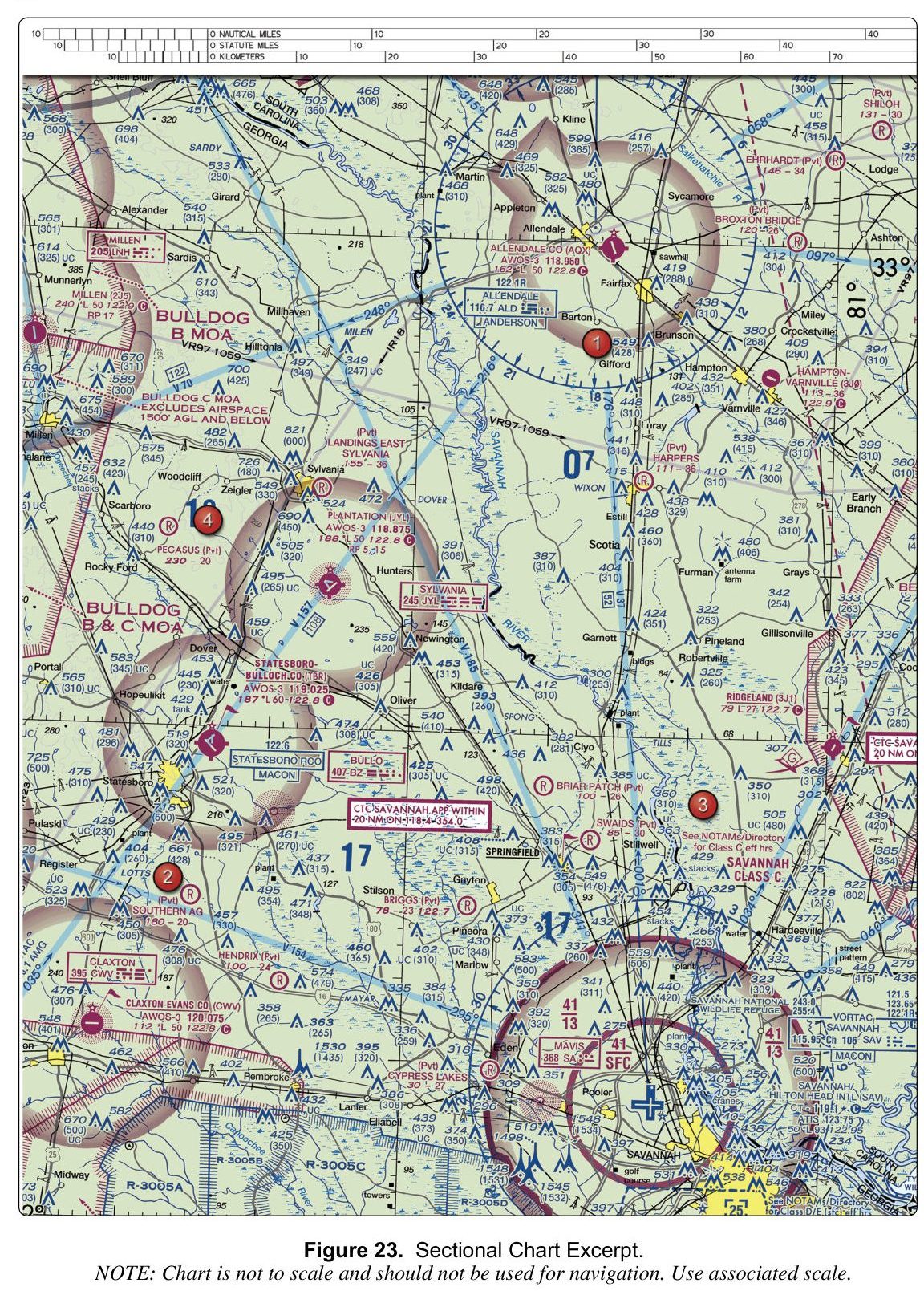
3. (Refer to FAA-CT-8080-2H, Figure 23.) The note printed on the chart for BULLDOG C MOA states that the MOA:
Figure 23 — Sectional chartOpen reference image
From the FAA testing supplement (FAA-CT-8080-2H). Tap the image to open it full size.
Why: On Figure 23, the special-use airspace labeled BULLDOG C MOA carries a printed note that reads 'EXCLUDES AIRSPACE 1500' AGL AND BELOW.' The unit is explicitly AGL, not MSL, so the option stating 1500' MSL is a misread of the unit. The value 1300' does not appear in the note; it may be confused with the 41/13 ceiling-over-floor figure printed on the Savannah Class C airspace nearby.
4. Before a Part 107 operation, the remote PIC is required to assess the operating environment. Which of the following is NOT part of that required operating-environment assessment?
Why: Battery charge level is not one of the items in the operating-environment assessment required by 14 CFR 107.49(a). That assessment covers local weather, local airspace and flight restrictions, persons and property on the surface, and other ground hazards. Available power is addressed separately in 107.49(d), which requires the remote PIC to ensure that a powered small UAS has enough available power for the intended operational time.
5. A remote pilot intends to operate three small unmanned aircraft under Part 107. Which statement about registration is correct?
Why: Part 107 operators must register each individual device separately, and each device is assigned a unique registration number. This differs from recreational registration, where a single registration number can be applied to all devices in the inventory. The same make and model does not allow a Part 107 pilot to share a registration number across multiple aircraft, and the requirement applies to all registered devices, not only those with a broadcast module.
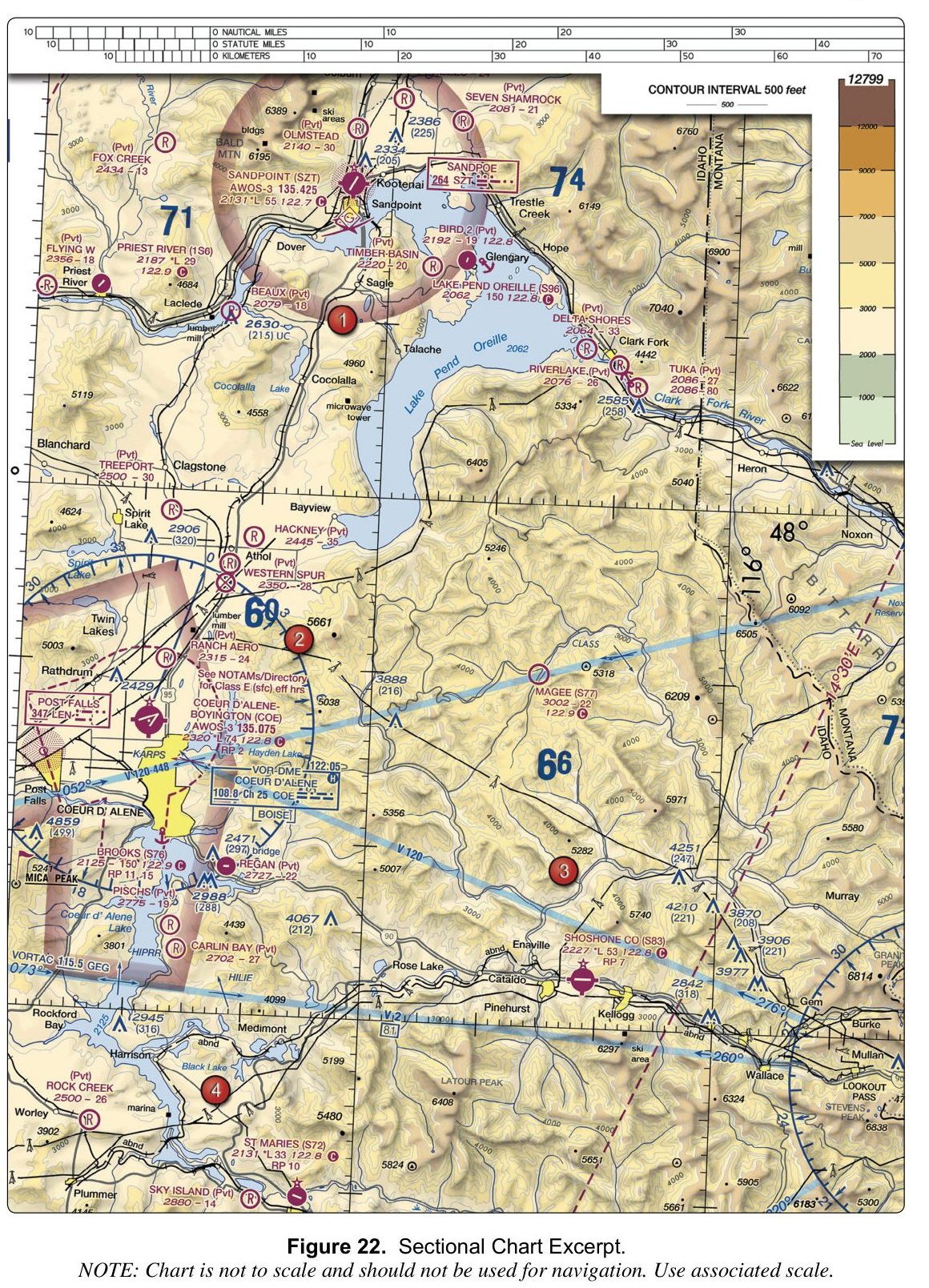
6. (Refer to FAA-CT-8080-2H, Figure 22.) What is the CTAF frequency for Priest River (1S6)?
Figure 22 — Sectional chartOpen reference image
From the FAA testing supplement (FAA-CT-8080-2H). Tap the image to open it full size.
Why: On the chart, the Priest River (1S6) airport entry lists its CTAF as 122.9, printed directly beside the airport identifier. The value 122.8 is the CTAF for several other airports on the same chart (Lake Pend Oreille, Coeur d'Alene-Boyington, Shoshone Co, St Maries), and 122.7 is the CTAF for Sandpoint (SZT). Read the frequency printed next to the 1S6 identifier to confirm 122.9.
7. Class D airspace typically extends from the surface up to about what height above the airport?
Why: Class D is usually a cylinder about 2,500 feet above the airport elevation, charted in MSL and rounded, with the exact figure on the sectional. 10,000 feet MSL is the typical top of Class B. Always read the chart for the airport you are flying near.
8. Which of the following is a valid purpose for which the FAA issues a Remote ID Letter of Authorization?
Why: The FAA explicitly states that it issues Remote ID Letters of Authorization to drone operators for the purpose of aeronautical research or to show compliance with regulations. This is a distinct mechanism from the standard Part 107 waiver process; it is a letter specifically tied to Remote ID requirements. The registration-extension option is wrong because a Remote ID Letter of Authorization has no bearing on registration validity, which is governed by separate registration rules. The altitude option is wrong because a Remote ID Letter of Authorization addresses only Remote ID compliance and does not modify any operational restriction such as the altitude limit, which would require a separate waiver or authorization.
9. A LAANC request is approved with a ceiling of 300 feet. What does this ceiling value refer to?
Why: LAANC ceilings are expressed in feet above ground level, ranging from 0 to 400 feet, and are never stated in mean sea level. The MSL option is wrong because the LAANC system and the UAS facility map use AGL values exclusively; converting to MSL would require knowing the local terrain elevation, which varies by location and is not how the ceiling is defined. The airport field elevation option is wrong for the same reason: the ceiling is a generic AGL value applied to the ground surface, not a fixed offset from a specific airport elevation. Pilots must account for local terrain when determining the actual MSL altitude at which the 300 ft AGL ceiling is reached.
10. A remote pilot's Category 3 drone has a category label that has become faded and partially illegible after prolonged sun exposure. What must the remote pilot do before conducting operations over human beings?
Why: If a Category 2 or Category 3 label is damaged, destroyed or missing, the remote pilot in command must relabel the aircraft in English, so that the label is legible, prominent and will remain on the aircraft for the duration of the operation, before flying over human beings. The label must correctly identify the category the aircraft is eligible for. There is no report to file with the FAA for a worn label, and removing it does not help: without a legible label the aircraft is not eligible for the operation, whether or not anyone inspects it.
11. A remote pilot in command experiences a battery failure that will cause the drone to crash within 30 seconds. The pilot deviates from the visual line of sight rule to maneuver the aircraft toward a safe landing area. Which statement is correct?
Why: In an in-flight emergency requiring immediate action, the remote pilot in command may deviate from any rule of Part 107 to the extent necessary to meet that emergency (14 CFR 107.21(a)), including visual line of sight, and no waiver is needed beforehand. The authority is not limited to particular rules such as altitude or speed. A waiver is a separate authorization for planned operations. If the FAA asks, the pilot must send a written report of the deviation (107.21(b)).
12. Which of these counts as sustained flight over an open-air assembly of people?
Why: Sustained flight includes hovering above people in the assembly, flying back and forth over it, or circling so that the drone stays above some part of it. A single transit that is merely incidental to a point-to-point flight unrelated to the gathering is not sustained flight. Hovering beside the crowd, however long, is not flight over it at all.
13. Which statement about Category 3 operations and open-air assemblies of people is correct?
Why: Under the standard rules, Category 3 drones may not fly over open-air assemblies of people. For Categories 1, 2 and 4, sustained flight over an open-air assembly requires the specified Remote ID compliance. A brief, one-time transit incidental to an unrelated point-to-point flight does not count as sustained flight. Neither provision permits Category 3 flight over an open-air assembly.
14. For an ordinary Part 107 small UA that is not being operated under the Category 4 requirements, the manufacturer recommends inspecting the electronic speed-controller connections every 10 flight hours. The aircraft now has 11 flight hours and no malfunction has been noticed. Which statement is most accurate?
Why: For an ordinary Part 107 small UAS, 14 CFR 107.15 does not prescribe recurring maintenance intervals or require a certificated mechanic for routine maintenance. It does require the small UAS to be in a condition for safe operation, and the remote PIC to check that condition before each flight. FAA Advisory Circular 107-2A recommends maintaining the small UAS in accordance with the manufacturer's instructions and adhering to manufacturer-recommended scheduled maintenance, so the 10-hour inspection should be performed rather than skipped because no malfunction has appeared. Category 4 is different: aircraft operated under 107.140 must have maintenance and inspections performed as that section requires.
15. (Refer to FAA-CT-8080-2H, Figure 23.) The obstacle just east of area 1, near Gifford, has a height of:
Figure 23 — Sectional chartOpen reference image
From the FAA testing supplement (FAA-CT-8080-2H). Tap the image to open it full size.
Why: Next to area 1, beside Gifford, the obstacle is labelled 549 with (428) beneath it. The bold number is the height of the top above mean sea level; the number in parentheses is its height above ground level. So it is 549 feet MSL, or 428 feet above the ground.
16. During a routine Part 107 night operation, the required anti-collision light fails completely. What should the remote PIC do?
Why: Section 107.29 prohibits operating at night without lighted anti-collision lighting visible for at least 3 statute miles with a flash rate sufficient to avoid a collision, so an ordinary night operation cannot continue once the light fails: the pilot should terminate it and land as soon as practicable. Strictly, 107.29 does not use the words "land as soon as practicable" (that phrase is in the Remote ID rule, 89.110); the point is that continued night flight would no longer comply with 107.29. Navigation lights do not meet the anti-collision requirement, and flying lower is not an exception. If an actual in-flight emergency exists, 107.21 allows deviation from the rules to the extent necessary to meet it.
17. A remote pilot certificate holder changes their permanent mailing address. Which statement correctly describes the FAA requirement?
Why: Under 14 CFR 107.77(c), a certificate holder who changes their permanent mailing address may not exercise the privileges of the certificate more than 30 days after the change unless the FAA has been notified, either by letter to the Airman Certification Branch or through the FAA web portal. The key point is that privileges stop after 30 days until the address is updated, not simply "written notification within 30 days." Any change of permanent mailing address counts, and no new certificate is required.
18. An applicant fails the Part 107 Initial Aeronautical Knowledge Test. What is the minimum waiting period before the applicant may retake it?
Why: Under 14 CFR 107.71, an applicant who fails a knowledge test may not reapply for 14 calendar days. Do not confuse this with recurrent requirements: remote pilots no longer take a recurrent knowledge test, and certificate holders maintain aeronautical knowledge recency by completing the FAA's online recurrent training every 24 calendar months.
19. A remote pilot's drone strikes a parked vehicle during a commercial aerial photography operation. The vehicle owner estimates the repair cost at $480. Which statement about the reporting requirement is correct?
Why: A remote pilot in command must report to the FAA within 10 calendar days any operation involving serious injury, loss of consciousness, or damage to property other than the drone, unless the repair cost does not exceed $500 (or the property is worth $500 or less if destroyed) (14 CFR 107.9). A $480 repair is below the threshold, so no report is required. Contact alone does not trigger a report, and there is no $100 threshold.
20. A drone operator conducting aeronautical research needs FAA authority to operate without Remote ID equipment. What is the appropriate mechanism?
Why: The FAA may issue a Remote ID Letter of Authorization (LOA) allowing eligible operators to operate without Remote ID or otherwise deviate from Remote ID requirements. FAA guidance specifically identifies aeronautical research and demonstrations of regulatory compliance as purposes for which a Remote ID LOA may be issued (14 CFR 89.120). Remote ID requirements are contained in 14 CFR Part 89, so they are not simply waived through the ordinary Part 107 operational-waiver process. There is also no special aircraft registration category that automatically produces the exemption described in the question.
21. For a drone subject to Remote ID requirements, with no Remote ID equipment and no separate FAA authorization to deviate, where may it be flown?
Why: A drone that must meet Remote ID but has no Remote ID equipment may fly only inside a FRIA, with the aircraft and the person manipulating the controls inside the FRIA and the aircraft within visual line of sight. There is no exception for private property or for uncontrolled (Class G) airspace. Drones not subject to registration or Remote ID requirements, and separately authorized operations, are outside this question.
22. A Part 107 remote pilot is registering a drone that uses a Remote ID broadcast module rather than built-in Standard Remote ID. During the registration process, which information must the pilot enter for this device?
Why: For Part 107 pilots using a Remote ID broadcast module, the FAA instructions direct the pilot to list the drone's make/model while adding the broadcast module's Remote ID serial number. Each device in the Part 107 inventory is registered separately and assigned a unique registration number. The 'only the module's serial number' option omits the required drone make/model information. The 'drone's serial number' option is incorrect because the instruction specifically calls for the drone's make/model, not its serial number, when registering a broadcast module device under Part 107.
23. What does a Part 107 certificate of waiver allow its holder to do?
Why: A certificate of waiver authorizes deviation only from the specific Part 107 regulations it lists, and the holder must comply with every condition and limitation in it (section 107.200). It is not general permission to depart from other rules, and an operational waiver does not by itself grant airspace authorization.
24. During a Part 107 flight, the battery begins depleting much faster than expected and may not provide enough power to complete the planned flight. What is the best action?
Why: Abnormal battery depletion can lead to a loss of power, so sound aeronautical decision-making is to terminate the mission and land at a suitable spot as soon as practicable, away from people and property, rather than rely on an automatic return-to-home that may not complete. Climbing uses more power and adds risk. If the situation becomes an in-flight emergency, section 107.21 permits deviation from Part 107 to the extent necessary to address that emergency.
Source: FAA Remote Pilot Study Guide (FAA-G-8082-22), emergency procedures; 14 CFR 107.21
25. Under Category 1, 2 or 3, when may a small drone be flown over people inside moving vehicles?
Why: Since 2021 Part 107 allows flight over moving vehicles in Categories 1 to 3 when the drone meets its category's requirements and either stays within or over a closed- or restricted-access site with everyone in the vehicles on notice, or does not maintain sustained flight over the moving vehicles. A waiver is needed only for operations outside those conditions, and vehicle speed is not a factor in the rule.
26. Part 107 regulations apply to small unmanned aircraft that weigh:
Why: Part 107 covers small unmanned aircraft weighing less than 55 lb, and it sets no minimum weight: a 100-gram drone operated under Part 107 is still subject to Part 107 and must be registered. The 250-gram figure people remember is a registration exemption for recreational flyers only, not a limit on Part 107, so the first option is wrong. The third option describes aircraft too heavy to be small unmanned aircraft at all.
27. A remote pilot is using a visual observer during a Part 107 operation. What is required regarding communication between the remote pilot and the visual observer?
Why: Section 107.33 requires the remote pilot in command, the person manipulating the controls and the visual observer to maintain effective communication with each other at all times. The regulation does not prescribe a particular communication technology, but whatever method the crew uses must actually keep communication effective throughout the operation. Requiring face-to-face contact adds a condition the rule does not contain, and communicating only when a hazard appears fails the at-all-times requirement.
28. A remote pilot completed Part 107 recurrent training on March 10, 2025. Through what date may the pilot exercise remote pilot privileges without completing further training?
Why: Section 107.65 requires the applicable knowledge test or training within the previous 24 calendar months. Calendar months run to the end of the month, so training completed on March 10, 2025 keeps the pilot current through March 31, 2027.
29. What is the difference in the location information broadcast by a Standard Remote ID drone versus a drone equipped with a Remote ID broadcast module?
Why: A Standard Remote ID drone is produced with built-in broadcast capabilities that provide identification and location information about the drone and the control station. A Remote ID broadcast module, by contrast, broadcasts identification and location information about the drone and its take-off location. This distinction matters operationally: the control station location is more dynamic (it updates as the pilot moves), while the take-off location is a fixed point established at the start of the flight.
30. For an ordinary Part 107 operation in Class C airspace, without a specific airspace waiver, what must the remote pilot in command obtain before the flight?
Why: Obtain prior ATC authorization, commonly through an approved LAANC service or FAA DroneZone. Filing a flight plan does not provide that authorization, and airport management cannot grant it. An operational waiver does not automatically authorize controlled-airspace access; specific airspace waivers also exist. The ordinary authorization requirement applies in Class B, C, and D airspace and within the lateral boundaries of a Class E surface area designated for an airport.
31. Under Part 107, how much time must pass after consuming an alcoholic beverage before a person may act as remote pilot in command, manipulate the flight controls, or serve as visual observer?
Why: Section 107.27 applies the alcohol and drug rules of section 91.17: no person may act as a crewmember within 8 hours after consuming any alcoholic beverage, while under the influence of alcohol, with a blood or breath alcohol concentration of 0.04 or greater, or while using any drug that affects their faculties in a way contrary to safety. Waiting 8 hours is necessary but not always enough: you must also no longer be under the influence.
32. A METAR includes the wind group 32015G22KT. What does it report?
Why: In a METAR the first three digits are the direction the wind is blowing from, in degrees true; the next two are the sustained speed in knots; G introduces the gust speed. 32015G22KT is from 320 degrees true at 15 knots, gusting 22 knots.
33. A remote pilot holds a Part 107 waiver for operations from a moving vehicle. Which of the following is NOT permitted under that waiver?
Why: A waiver of the moving-vehicle rule cannot permit the transport of another person's property for compensation or hire. This is an absolute limitation that no waiver can override. The other two options describe activities that fall within the standard rule (flight from a moving land or water vehicle over a sparsely populated area) or a properly scoped waiver, and neither involves compensated transport of another person's property.
34. A remote pilot deliberately places false information in a report that is required to demonstrate compliance with Part 107. Which statement is correct?
Why: FAA falsification rules are in 14 CFR 3.403, which prohibits fraudulent or intentionally false statements in documents submitted under the covered regulations and in documents kept, made, or used to show compliance with them. Part 107 is covered (14 CFR 3.401(a) includes subchapter F). The violation does not depend on whether the flight itself was legal or whether the document was submitted to the FAA. The former Part 107 falsification provision, 107.5, is now reserved, so current study material should cite 3.403.
35. What registration does a drone flown under Part 107 need?
Why: A drone operated under Part 107 must have the required FAA registration regardless of its weight. DroneZone registration is the usual route for small drones; qualifying aircraft may instead be registered through the aircraft registry. State registration does not replace FAA registration, and 55 pounds is not a minimum registration threshold.
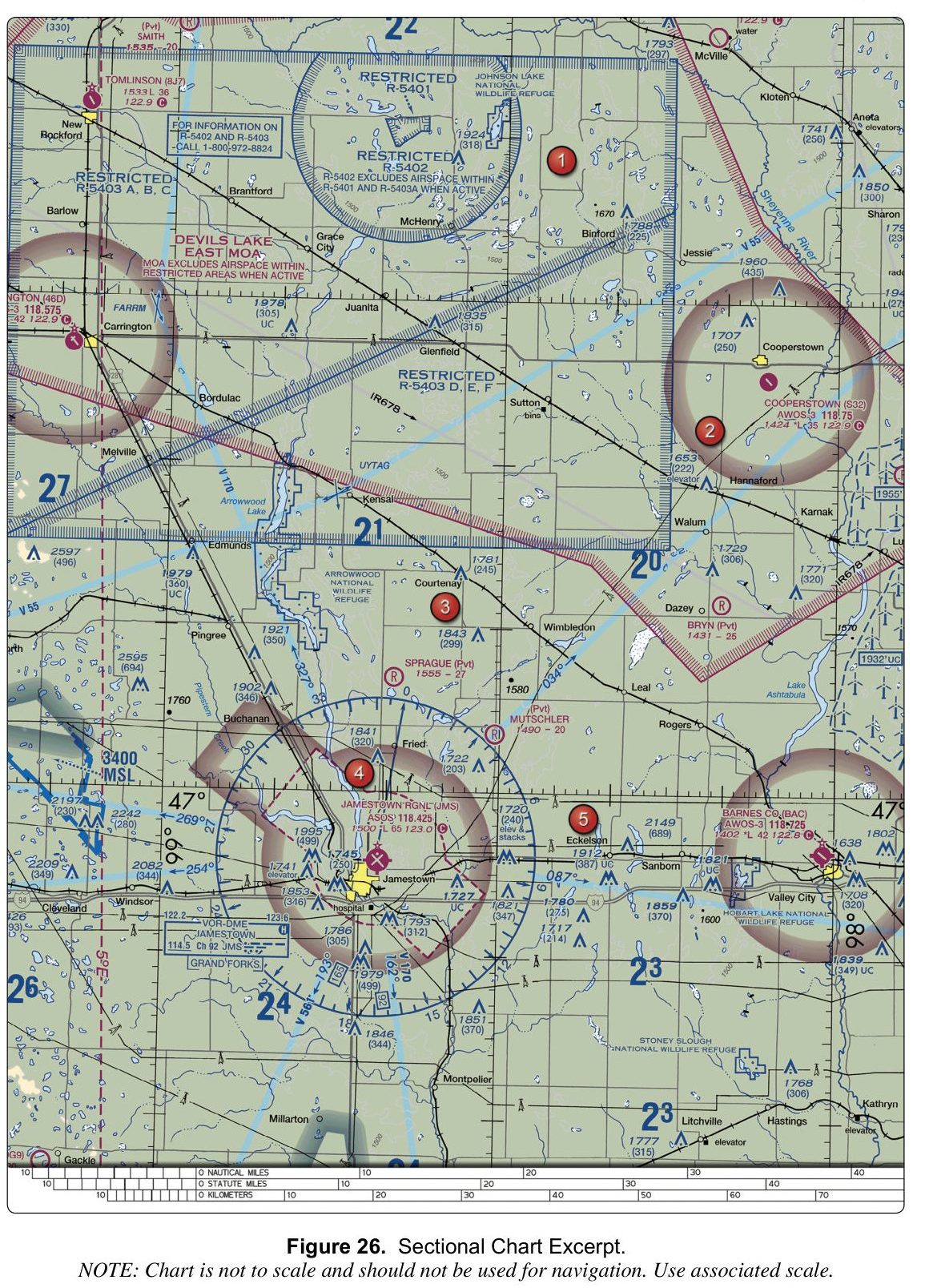
36. (Refer to FAA-CT-8080-2H, Figure 26.) What is the field elevation listed for Barnes Co. (BAC)?
Figure 26 — Sectional chartOpen reference image
From the FAA testing supplement (FAA-CT-8080-2H). Tap the image to open it full size.
Why: On the chart, the Barnes Co. (BAC) airport entry lists the field elevation as 1402 feet. The value 1533 feet is the elevation for Tomlinson (8J7), and 1431 feet is the elevation for Bryn (Pvt). Each airport's elevation is printed directly beside its name in the airport data block.
37. Which of the following operations requires a Part 107 waiver?
Why: Under section 107.39 a small UAS may be flown over a person who is directly participating in the operation, or who is under a covered structure or inside a stationary vehicle that provides reasonable protection, without any category. Over anyone else, the aircraft and operation must meet Category 1, 2, 3 or 4; otherwise a waiver is required. Night flight with proper anti-collision lighting and a trained pilot is a standard operation, and so is flight in Class D airspace with prior authorization through LAANC or DroneZone; neither needs a waiver.
38. At what minimum rate must a Remote ID broadcast be transmitted?
Why: Under the Remote ID rules in Part 89, standard Remote ID aircraft and Remote ID broadcast modules must broadcast the required message elements at least once per second. Broadcasts every five or thirty seconds fail that minimum.
39. A remote pilot plans to fly inside the actual three-dimensional volume of Class C airspace at a local airport. Which statement correctly describes the authorization requirement?
Why: For an ordinary Part 107 operation inside Class C airspace, the remote pilot must obtain prior ATC authorization through LAANC or FAA DroneZone. A position merely beneath a Class C shelf may be outside the Class C volume; pilots must use the sectional chart to identify the actual lateral and vertical boundaries. An authorization ceiling applies to the area and altitude specified in the authorization.
40. A drone light show operator holds a valid Part 107 waiver for their operation and wants to fly without Remote ID equipment. Which of the following is correct?
Why: The FAA issues Remote ID Letters of Authorization to operators who need to deviate from Remote ID requirements, and drone light shows conducted under an FAA-issued waiver are specifically identified as a type of operation that may be eligible for such a letter. The existing Part 107 waiver option is wrong because a Part 107 waiver addresses Part 107 operational rules and does not by itself exempt an operator from the separate Remote ID rule. The FRIA option is wrong because while an FRIA does allow operation without Remote ID, it is not the only mechanism available, and the question asks what the operator may do given their specific circumstances (holding a waiver for a light show), for which a Letter of Authorization is the applicable path.
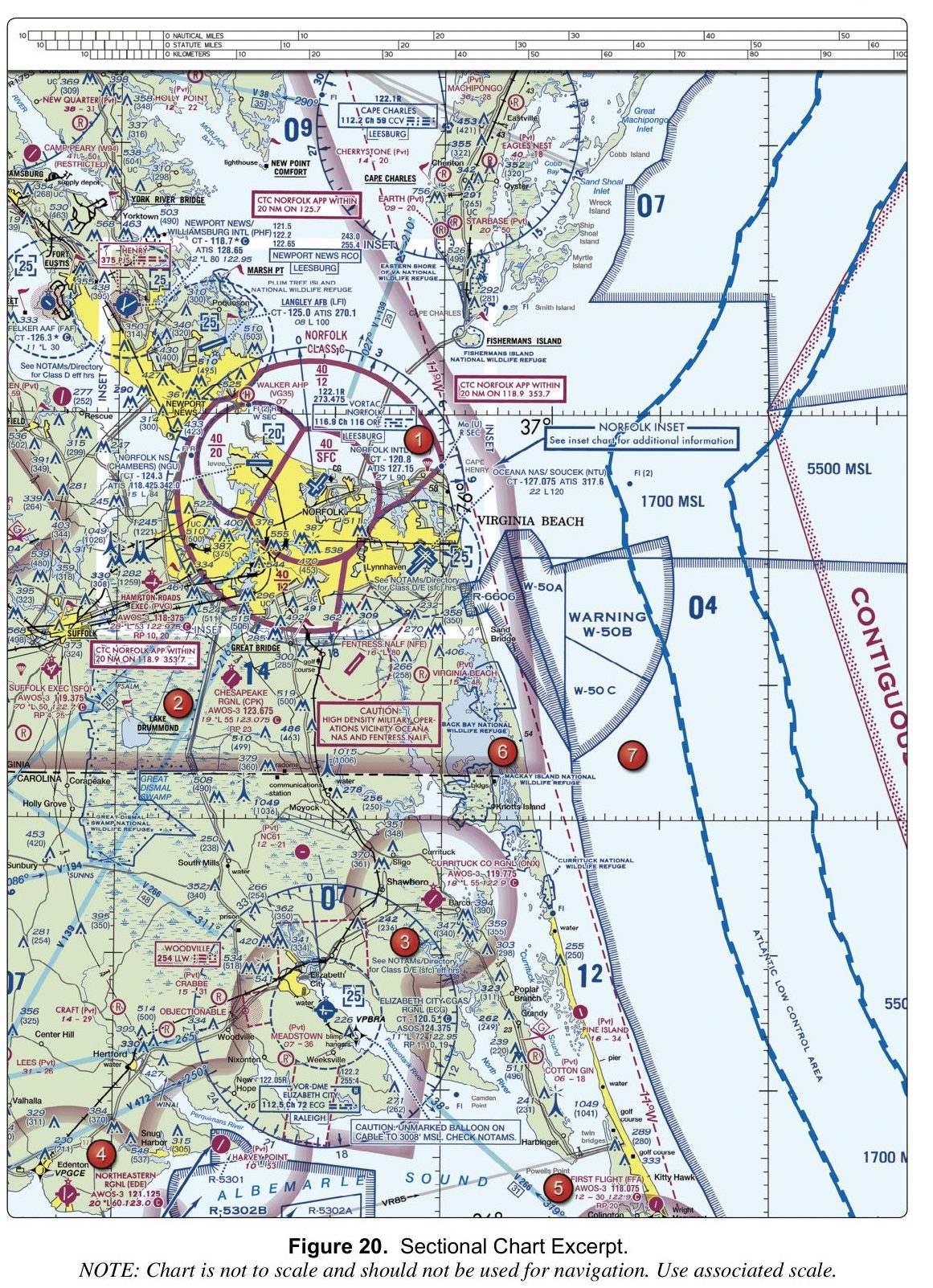
41. (Refer to FAA-CT-8080-2H, Figure 20.) What is the tower frequency for Newport News/Williamsburg International (PHF)?
Figure 20 — Sectional chartOpen reference image
From the FAA testing supplement (FAA-CT-8080-2H). Tap the image to open it full size.
Why: In the airport data block for Newport News/Williamsburg Intl (PHF), 'CT - 118.7' is the control tower frequency. 128.65 is the ATIS frequency printed on the line below it, and 118.425 is the ATIS frequency for Norfolk NS (Chambers), a different airport on the chart.
42. During preflight inspection, a remote pilot discovers that a payload on a conventional fixed-wing small UA has been mounted far enough aft to place the center of gravity beyond the manufacturer's aft CG limit. What is the primary flight-control risk?
Why: Moving the CG aft reduces longitudinal static stability. As the CG approaches or exceeds the aft limit, pitch response becomes more sensitive and the aircraft's tendency to return to its trimmed condition weakens. Stall and spin recovery also become more difficult because adequate nose-down pitch authority may no longer be available. Increased pitch stability, heavy nose-up forces and a higher stall speed are forward-CG effects. An aircraft outside its approved CG envelope should not be flown.
43. The IMSAFE mnemonic used by remote pilots to evaluate personal fitness for flight stands for:
Why: The IMSAFE checklist covers Illness, Medication, Stress, Alcohol, Fatigue, and Emotion (some FAA publications also include Eating). The 'sleep' option is wrong because IMSAFE addresses fatigue as a broad condition, not specifically sleep deprivation as a separate item. The 'injuries' option is wrong because the mnemonic uses 'Illness,' which encompasses both acute and chronic health conditions but is the specific word in the acronym.
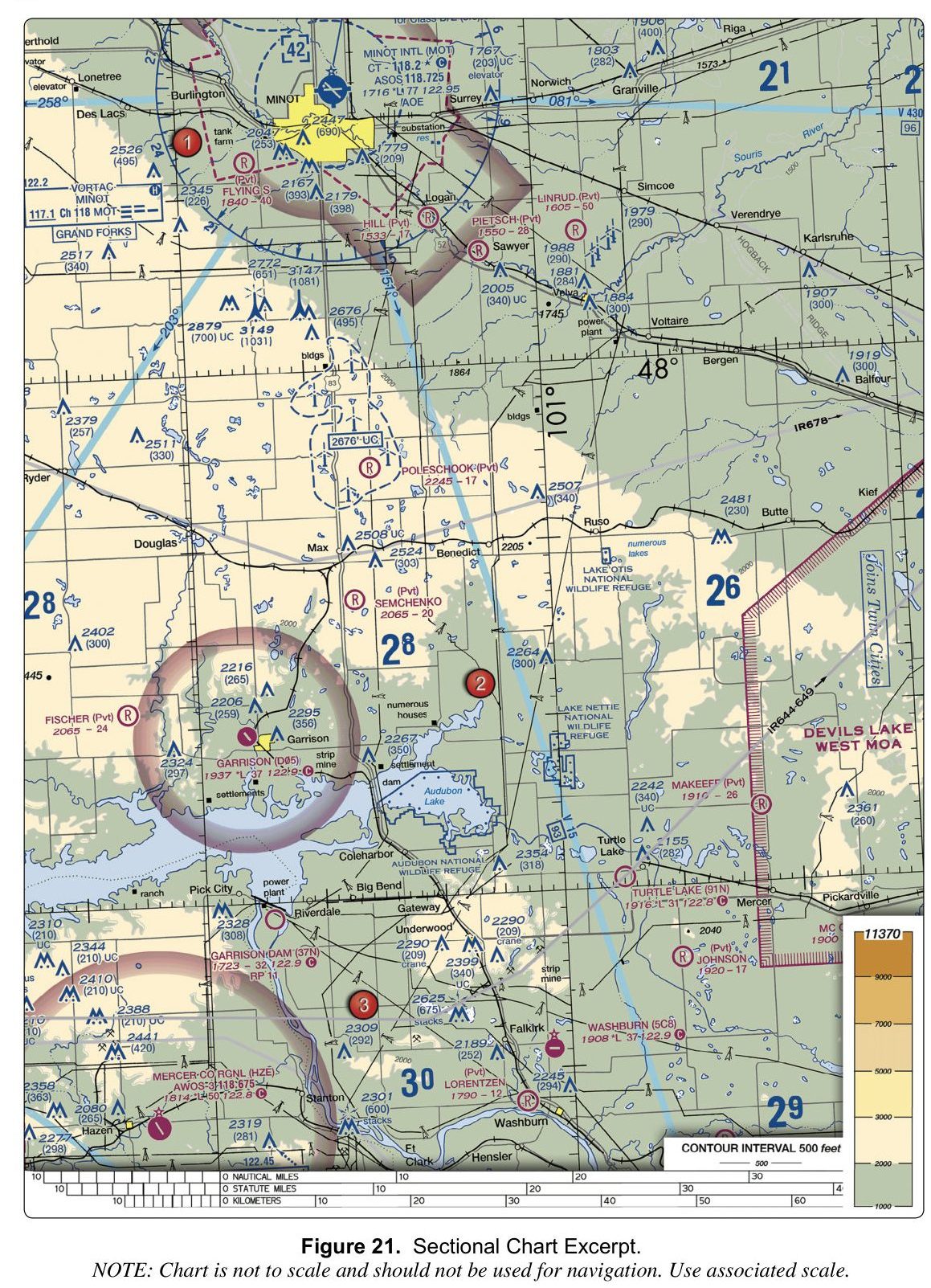
44. (Refer to FAA-CT-8080-2H, Figure 21.) What is the CTAF for Minot Intl (MOT)?
Figure 21 — Sectional chartOpen reference image
From the FAA testing supplement (FAA-CT-8080-2H). Tap the image to open it full size.
Why: In the Minot Intl (MOT) data block, 'CT - 118.2' is the control tower frequency. The star means the tower operates part-time, and the C in a circle after it means 118.2 is also the CTAF when the tower is closed. 118.725 is the ASOS weather frequency on the next line. 122.9 is the CTAF at other airports on the chart, such as Garrison Dam and Washburn.
45. Before flight, what does Part 107 require the remote pilot in command to do about weather?
Why: Part 107 makes the preflight assessment the remote pilot's own duty: before flight they must assess the operating environment, and that assessment must include local weather conditions, local airspace and flight restrictions, the location of people and property, and other ground hazards. A Flight Service briefing is good practice but no particular source is required, and Part 107 sets no ceiling minimum: its weather limits are 3 statute miles of visibility and 500 feet below and 2,000 feet horizontally from clouds.
46. A remote pilot plans to fly a 0.4 lb drone for a commercial aerial mapping job under Part 107. Must the drone be registered with the FAA?
Why: Every drone flown under Part 107 must be registered, whatever it weighs, so a 0.4 lb drone used for a paid mapping job needs registration. The 0.55 lb exemption applies only to drones flown purely for recreation, so applying it to a commercial flight is wrong. It is also wrong to say registration applies only to recreational flyers: that inverts the rule.
47. A remote pilot flying near a non-towered airport hears on the CTAF: 'Traffic, Cessna 123 is on a two-mile final, runway 27.' What should the remote pilot do?
Why: Monitoring the CTAF gives the remote pilot awareness of manned traffic; it does not give the drone priority, and announcing the drone's position does not either. Section 107.37 requires the small unmanned aircraft to yield the right of way to all aircraft and not create a collision hazard, so the drone must stay clear of the arriving aircraft's final approach path. Staying below 400 feet AGL does not help: on a normal approach, a Cessna on a two-mile final is only about 600 feet above the ground.
48. A remote pilot holds a Part 107 waiver for operations over people and wants to fly without broadcasting Remote ID. Which statement is correct?
Why: A Part 107 waiver covers only the Part 107 sections listed in 107.205. Remote ID is a separate rule: no person may operate without meeting the Remote ID requirements except as otherwise authorized by the Administrator or in an FAA-recognized identification area (14 CFR 89.105). The FAA gives that authorization separately and only for limited purposes, such as aeronautical research, so holding a Part 107 waiver of any kind does not remove the Remote ID requirement.
49. Which of the following is NOT a rule that can be waived under the Part 107 waiver process?
Why: 14 CFR 107.205 lists the sections a certificate of waiver can cover, including visual line of sight (107.31) and yielding the right of way (107.37(a)). The accident-reporting rule, 107.9, is not on that list, so an operation that causes serious injury, loss of consciousness, or property damage over $500 must be reported within 10 calendar days whatever waivers the operator holds.
50. A remote pilot is conducting an operation that requires a visual observer to help maintain visual line of sight. Mid-operation, the visual observer's communication device fails and they can no longer maintain effective communication with the remote pilot. What must the remote pilot do?
Why: Part 107 requires the remote PIC to ensure effective communication with any visual observer at all times during the operation. If that communication is lost, the remote PIC can no longer rely on that visual observer to help maintain visual line of sight, and the operation must be suspended until communication is restored or the need for that visual observer is eliminated. The 'present at the start' option is wrong because the requirement is continuous, not a one-time condition satisfied at the beginning. The 'onboard cameras' option is wrong because visual line of sight is defined by unaided human vision from the control station or a visual observer, not by the aircraft's own sensors.